Day Trip to Toluca by Train
Toluca is the capital of the State of Mexico, an hour west of the city on the other side of the mountains. Most people from Mexico City know it for its chorizo, its football team and its traffic. What they mostly don’t know is that the old center has one of the great sights of the country, the Cosmovitral, a former market hall turned into a botanical garden under a stained-glass sky. Around it are the 19th-century arcades, a cathedral that took a hundred years to build, and a cluster of small, free museums. Since February 2026 the new train goes all the way from Observatorio, so you can do it in a day without a car.
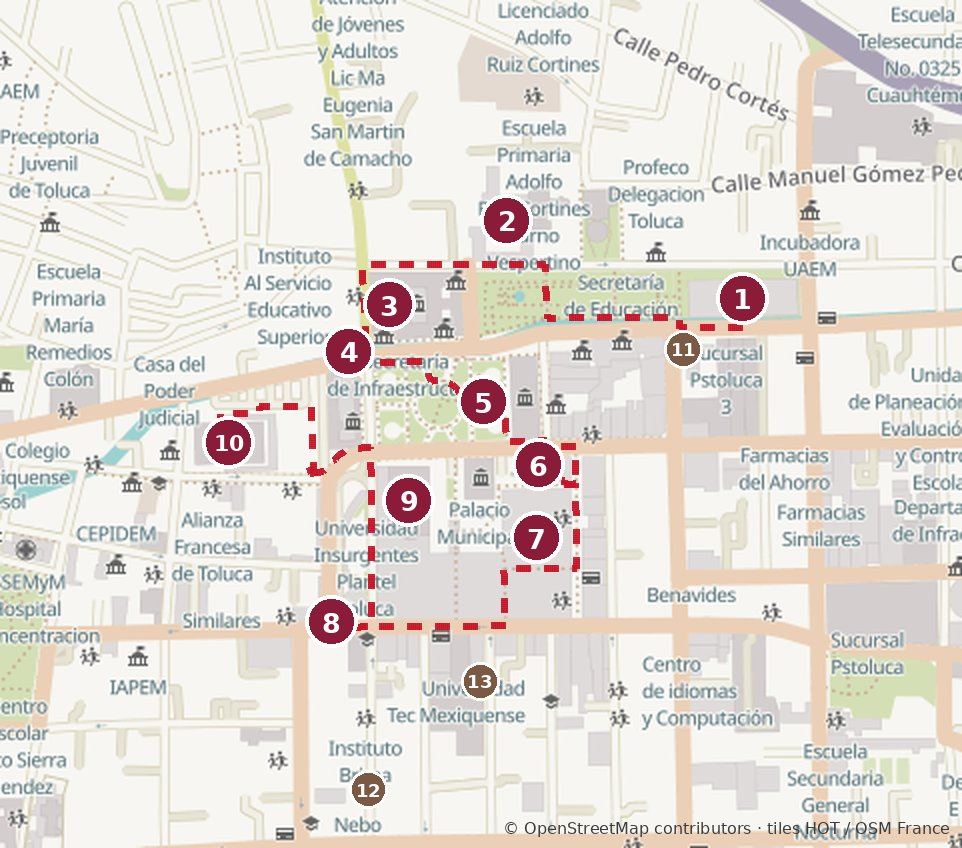
The 10 numbered stops are the sights. They follow a one-way route of about 2.1 km (1.3 miles), roughly 30 minutes on foot without stops, from the Cosmovitral at the east end of the center to the Teatro Morelos at the west end. Take a taxi from the station to the start and another back from the end.
Map key: 1 Cosmovitral · 2 Museo de Bellas Artes · 3 Palacio de Gobierno · 4 The museum corridor · 5 Plaza de los Mártires · 6 Santa Veracruz · 7 Los Portales · 8 Calle Hidalgo and the Plaza González Arratia · 9 Cathedral · 10 Teatro Morelos
Coffee: 11 Café Punta del Cielo Cosmovitral · 12 A donde sea Cafetería de Especialidad · 13 Café Colbert
Getting there: the El Insurgente train
Observatorio station to Toluca Centro station · daily from 5 AM (Sat 6, Sun 7), last train 10:30 PM · 90 pesos (~4.70 USD) each way
The Tren Interurbano México–Toluca, called El Insurgente, has seven stations. From east to west they are Observatorio, Vasco de Quiroga, Santa Fe, Lerma, Metepec, Toluca Centro and Zinacantepec (Wikipedia). The last stretch, Santa Fe to Observatorio, opened on February 2, 2026, so the whole line now runs. It’s about 58 km.
Get off at Toluca Centro, the stop for downtown, not at Zinacantepec at the end of the line. The ride from Observatorio takes a little under an hour. Sit on either side. The train climbs over the forests of the Sierra de las Cruces on high viaducts, goes through a long tunnel near La Marquesa and comes down into the flat, wide Toluca valley (more on the views in Far West).
- Frequency. About every 10 minutes
- Hours. First trains at 5 AM on weekdays, 6 AM on Saturdays and 7 AM on Sundays and holidays. Service used to run until midnight, but since August 10, 2026 the last train leaves at 10:30 PM “until further notice”, for track maintenance
- Fares. Charged by distance. Observatorio to Toluca Centro is 90 pesos, to Zinacantepec 100 pesos. Vasco de Quiroga or Santa Fe to Toluca Centro is 80 pesos (~4.20 USD)
- Paying. Use the same rechargeable public transportation card as the Metro and the cable car (Tarjeta de Movilidad Integrada, or “MI” card), 15 pesos (~0.80 USD) for the card itself (see Getting Around). Tap in and tap out. You need enough balance to cover the longest trip when you enter, and the difference is settled at the exit gates (México Desconocido). So load at least 100 pesos each way. If you don’t have a card, the ticket booths at each station entrance sell single-use QR tickets
Getting to Observatorio
Observatorio is at the west end of Metro Line 1 (pink), which reopened all the way out there in November 2025 (Excélsior). The train terminal is on top of the Metro station, connected by walkways (Chilango).
- From Roma or Condesa. Metro Line 1 from Insurgentes, Sevilla or Chapultepec station to Observatorio, the end of the line. About 15 to 20 minutes
- From Polanco. Metro Line 7 (orange) from Polanco or Auditorio south to Tacubaya, change to Line 1, and ride one stop west to Observatorio
- By Uber or taxi. 20 minutes to the better part of an hour, depending on traffic. Ask for the Tren Interurbano terminal, not the Terminal Poniente bus station next to it
From Toluca Centro station to the center
The station is at Boulevard Solidaridad Las Torres and Avenida Pino Suárez, next to Toluca’s main bus terminal (Wikipedia). That is about 3 km south of the old center. Despite the name, it is not in the centro.
- Taxi or Uber. The easy way. 10 to 15 minutes to the Cosmovitral. Ask for “el Cosmovitral, Lerdo y Juárez”
- Bus. City buses marked “Centro” run up from the station area. Cheap, slower, and you’ll need small change
- Walking. About 45 minutes up Pino Suárez and Juárez, along busy avenues. Possible, not pleasant
On the way back, do the same in reverse. A taxi from the Teatro Morelos to the station takes about 15 to 20 minutes.
A walk through the old center
Coffee before you start: 11 Café Punta del Cielo, Juárez Norte 206, right across from the Cosmovitral, is where to wait if you arrive before it opens at 10 (Wanderlog). It’s a Mexican chain, but reliable
1. Cosmovitral Jardín Botánico
Lerdo de Tejada at Juárez · Tue–Sun 10 AM – 6 PM · 25 pesos (~1.30 USD)
The reason for the trip. The building went up in 1909–1910 as the 16 de Septiembre market, Toluca’s first permanent market, in art nouveau style. When the market moved out in 1975, the state hired the painter Leopoldo Flores to fill the windows. He and his team built the glass between 1978 and 1980 (Wikipedia).
The numbers. About 3,200 m² of stained glass in 71 panels, some 500,000 pieces of glass in 28 colors, imported mostly from Italy, Germany, France, Belgium, Japan, Canada and the United States, and about 25 tons of lead to hold it together (Wikipedia). The city calls it the largest non-religious stained-glass work in the world (CDMX Secreta). I can’t check that, and it doesn’t matter. Walking in, it is like being inside a kaleidoscope.
The theme is the universe and its opposites, day and night, life and death. The main panel is the Hombre Sol, the “Sun Man”, a human figure inside a burning sun. Each spring equinox the setting sun lines up with it for about 20 minutes, and there’s a classical concert to mark it (Wikipedia). Flores did it with Bernabé Fernández and about 60 craftsmen (adn40).
Under the glass is a real botanical garden, with over 500 plant species, ponds with fish, little bridges, a cactus section and a Japanese corner with a friendship lantern from Saitama prefecture in Japan. Allow an hour. Go on a sunny day, when the colors are much stronger.
Walk west across the Plaza Garibay, the long square in front of the Cosmovitral. The next stop is on its north side, about 340 m or four to five minutes away.
2. Museo de Bellas Artes (ex-convento del Carmen)
Santos Degollado, north side of the Plaza Garibay · Tue–Sat 10 AM – 6 PM, Sun 10 AM – 3 PM · free · hours
The oldest museum in Toluca, opened in 1945 in a convent the Discalced Carmelites built between 1697 and 1711, next to their church, the Templo del Carmen (Wikipedia). The old convent building is half the attraction. The collection is mostly colonial religious art, with baroque paintings by Miguel Cabrera and Cristóbal de Villalpando, 18th-century carved saints, and an ivory Christ that came over on the Manila galleon. Stick your head into the church next door too.
Continue west along Lerdo de Tejada to the long colonial-looking building on the north side of the main square, about three minutes away.
3. Palacio de Gobierno
North side of the Plaza de los Mártires
The seat of the State of Mexico government. It looks colonial, in red tezontle stone and gray cantera, but it was built in 1967, when the governor demolished several old buildings on this side of the square to make room for it (Tlatoani). The other buildings around the plaza got matching facades at the same time, which is why the whole square looks of a piece. Inside are four large murals on state and national history, painted for the 2010 bicentennial (La Chispa). If the guards let you into the courtyard, have a look. Bring ID.
At the west end of the Palacio, turn right onto Nicolás Bravo. The museums are in the first block, a minute away.
4. The museum corridor: José María Velasco, Felipe Santiago Gutiérrez and Nishizawa
Lerdo de Tejada and Nicolás Bravo Norte, next to the Palacio de Gobierno · Tue–Sat 10 AM – 6 PM, Sun 10 AM – 3 PM · free
Three small state museums in a row, each devoted to one painter, part of what the state calls its corredor de la plástica. You can do all three in an hour, or pick one.
- Museo José María Velasco, on the corner. Velasco (1840–1912) was the great painter of the Valley of Mexico, the volcanoes and the old lakes, and helped shape the way Mexicans picture their own country (Milenio). If you only see one, see this one
- Museo Felipe Santiago Gutiérrez, for the 19th-century academic painter, in an 18th-century building (Lonely Planet)
- Museo Taller Nishizawa, for Luis Nishizawa (1918–2014), the Mexican-Japanese muralist and landscape painter
Walk back down Bravo to Lerdo de Tejada and cross into the Plaza de los Mártires, about two or three minutes.
5. Plaza de los Mártires
Toluca’s main square, a big open space with the Palacio de Gobierno on the north side and the cathedral on the south. The martyrs are a group of independence fighters who were executed here by the Spanish on October 19, 1811 (HMdb).
Cross the plaza to its southeast corner and walk east along Independencia, past the side of the cathedral (you’ll come back to it later). The next church is about three or four minutes away.
6. Templo de la Santa Veracruz
Independencia, east of the cathedral · free · HMdb
Smaller, older and more loved than the cathedral. Construction began in 1753 on the ruins of a 16th-century Franciscan chapel, and later changes made it mostly baroque. People come for the Cristo Negro, a crucified Black Christ. The legend says two young men brought it to sell to a nobleman, and when he bent down to pick up the coins they had vanished. It still goes out in procession every Holy Week (HMdb).
The arcades start just south of it, across the street, about three minutes away.
7. Los Portales
Toluca’s arcades run around three sides of the block south of the cathedral. Construction started in 1832 under the governor José María González Arratia. There are 37 arches on the east side (Portal 20 de Noviembre), 44 on the south (Portal Madero) and 35 on the west (Portal Reforma), plus four more at the entrance from Independencia, which makes the famous 120 (Wikipedia). Walk the whole U.
Under the arches are shops, candy and liquor counters and, most of all, the alacenas, tiny food counters that have been here for more than a century (Posta). This is where you eat.
Food: Toluca’s most famous food is chorizo, so much so that people from Toluca get nicknamed after it (Wikipedia). There’s the usual red chorizo, and chorizo verde, green from tomatillo and cilantro (Vice). Order it in a torta (sandwich)
Food: La Vaquita Negra del Portal, Portal Reforma 124-B, at the northwest corner of the arcades by the cathedral, a delicatessen with hams and sausages hanging over the counter, in business since 1943 (Lonely Planet). Daily 8:30 AM – 9 PM (Zona Turística). Get the toluqueña, red chorizo with white cheese, cream, tomato and salsa verde, or the green chorizo torta, and buy a chorizo to take home · the alacenas along the arcades, for example Tortas Lupita, there since 1945, which claims to have invented the torta toluqueña and the tecolota, a roll filled with chilaquiles (Posta). Tortas from about 20 to 60 pesos (~1–3 USD)
Drink: moscos (also called mosquitos), the local liqueur, made from cane alcohol, sugar and orange and aged for months in barrels. It’s sold at the little liquor counters under the arches, and has been for close to 100 years (Escapadah). Sweet, strong, 19 to 45 degrees depending on the bottle. One is plenty at 2,660 meters
Sweets: at the candy stalls, look for candied fruit and jamoncillo (milk fudge). In October and early November the portales and the plazas around them fill with alfeñique, sugar-paste skulls and figures for the Day of the Dead. The Feria del Alfeñique runs during that season with stalls, concerts and events around the center. In 2026 it runs from October 3 to November 2, in the Plaza Fray Andrés de Castro next to the portales, the Plaza González Arratia, the Alameda and the Mercado Juárez
Coffee: 12 A donde sea, Nicolás Bravo Sur 220, specialty coffee two blocks south of the Portal Reforma · 13 Café Colbert, Mariano Matamoros 100 (Wanderlog)
Leave the portales by the south side, the Portal Madero. The street in front of you is Hidalgo.
8. Calle Hidalgo and the Plaza González Arratia
Avenida Miguel Hidalgo, along the south side of the portales
The old main street of the town, running along the Portal Madero and on to the west. Turn right and walk two blocks to the Plaza González Arratia, about four minutes from the portales. It is named for the governor who started the portales, on the site of an old market that burned in 1935 (HMdb).
Food: Biarritz, Nigromante 200, facing the Plaza González Arratia, an old-fashioned restaurant that, as one guide puts it, “got stuck in time”. Chilaquiles toluqueños, molcajetes and homemade orange bread. Mon–Fri 7 AM – 10 PM, weekends 7 AM – 8 PM (Zona Turística). Good for a sit-down lunch if tortas at a counter aren’t your thing
Optional westward extension. If you have the time and the legs, keep going west along Hidalgo. It is about 450 m, six minutes, to the Alameda at the end of the street, and the same back. On the way:
- Museo de Numismática del Estado de México, Hidalgo Poniente 506 (Tue–Sun 10 AM – 6 PM · 10 pesos / ~0.50 USD). The history of money in Mexico from pre-Hispanic times to today. Look for the early 20th-century Toluca coin made of cardboard. I’m biased, being in the coin business, but it’s a good small museum
- Museo de la Acuarela, around the corner on Melchor Ocampo, a museum of watercolor painting
- The Alameda, the town’s old park, at the end of the street. Find a bench, then walk back to the Plaza González Arratia
From the Plaza González Arratia, walk north up Bravo past the Portal Reforma to the cathedral, about two or three minutes.
9. Catedral de Toluca
South side of the Plaza de los Mártires · daily until about 7 PM · free
The cathedral of San José took more than a century to build. The first stone was laid in 1867 on the site of the old Franciscan convent, work stopped for most of a hundred years, started again in 1951 and finished in 1978 (Wikipedia). So it’s a neoclassical design finished in the age of disco. The dome has a bronze San José with the child Jesus on top, and inside the complex you’ll find the baroque facade of the older 18th-century church of San Elzeario, which the cathedral swallowed, now the Parroquia del Sagrario (Food & Pleasure).
On Sundays the cathedral forecourt fills with stalls selling gorditas de nata, small thick sweet pancakes made with cream and cinnamon. Have one with café de olla or hot chocolate (Food & Pleasure)
Leave by the west side and walk west along Independencia and Aquiles Serdán. The theater is about 360 m, five minutes away.
10. Teatro Morelos
Lerdo de Tejada at Aquiles Serdán · HMdb
The state’s main theater, opened in 1969, with a bronze statue of the independence hero José María Morelos on horseback in front. It’s a 1960s civic building and you won’t go in unless there’s a show, but have a look at the statue before you leave.
This is where the walk ends. Take a taxi or Uber back to Toluca Centro station from here, about 15 to 20 minutes, or stop at the Mercado Juárez on the way (see below).
Optional extras
- Mercado Juárez. Toluca’s big market, about 2.5 km southeast of the center but only a kilometer from the train station. On the way back, have the taxi drop you here, look around, and walk the last 15 minutes to the station. During the Alfeñique fair it is one of the fair’s venues (Time Out)
- Centro Cultural Mexiquense. A large state cultural complex 4.5 to 5 km west of the center, out past the edge of town, with the state’s museums of anthropology and history, modern art (in a round building first designed as a planetarium) and popular cultures, the last in an old hacienda (Wikipedia). Tue–Sat 10 AM – 6 PM, Sun 10 AM – 3 PM (Tus Buenas Noticias). Worth it if you’re into pre-Hispanic archaeology, but it’s a separate half day. Taxi from the center
- Amaranta, chef Pablo Salas’s modern State of Mexico cooking, which has been on the Latin America’s 50 Best Restaurants list (Food & Pleasure). South of the center, so a taxi ride. Book ahead
Practical
| Toluca by train | |
|---|---|
| Time needed | a full day, about 11 hours door to door from Roma, 7 of them in Toluca |
| Walking | about 2.1 km in town (3 km with the Hidalgo extension), plus the stations |
| Best day | Tuesday to Saturday. Sunday works, but the museums close at 3 PM |
| Closed | Mondays (the Cosmovitral and all the museums) |
| Cost | train 90 pesos each way, Cosmovitral 25 pesos, most museums free, taxis extra |
| Altitude | 2,660 m, about 400 m higher than Mexico City (Wikipedia) |
| Weather | colder than the city. Average highs around 22 °C, nights around 5 °C, frost in winter |
| What to bring | a real jacket even in summer, sunscreen, comfortable shoes, the MI card loaded with at least 200 pesos, cash for the alacenas, ID for the Palacio de Gobierno |
Toluca is cold. The yearly average low is under 5 °C and frost is common in winter (Wikipedia). The sun is strong, the shade is cold, and in the rainy season (roughly June to October) the afternoons often bring a downpour. Dress in layers.
A suggested day
Tuesday to Saturday.
- 8:00 AM Metro Line 1 from Roma to Observatorio (from Polanco, Line 7 to Tacubaya and change)
- 8:30 AM El Insurgente west from Observatorio. Sit by a window for the mountains
- 9:25 AM Arrive at Toluca Centro. Taxi to the Cosmovitral
- 9:45 AM Coffee at Café Punta del Cielo across the street
- 10:00 AM The Cosmovitral opens. An hour under the glass
- 11:15 AM Museo de Bellas Artes, then the Palacio de Gobierno
- 12:00 PM The three painters’ museums on Bravo
- 1:00 PM The Plaza de los Mártires and the Santa Veracruz
- 1:45 PM Lunch in the portales: chorizo tortas at La Vaquita Negra or the alacenas, or sit down at Biarritz. A mosco to finish. This is the normal Mexican lunch hour anyway
- 3:15 PM Calle Hidalgo and the Plaza González Arratia, and if you have the energy, on to the coin museum and the Alameda and back
- 4:15 PM Coffee at A donde sea, two blocks south on Bravo
- 4:45 PM The cathedral, then the Teatro Morelos
- 5:15 PM Taxi to the station, with a stop at the Mercado Juárez if you have the energy
- 6:00 PM Train back to Observatorio, home by 7:30. The last train is at 10:30 PM, so there’s slack
Open questions
- Cosmovitral hours. Posta (May 2026) and adn40 (updated July 2026) give Tue–Sun 10 AM – 6 PM and 25 pesos. Chilango (July 2025) says Sundays close at 3 PM, and Wikipedia has older hours (9 AM – 6 PM, 10 pesos). I used Tue–Sun 10 – 6
- Cosmovitral free on Wednesdays. Only adn40 (2026) says so. Not in the text until confirmed
- “71 colors”. The sources say 71 panels (modules) and 28 colors, so I wrote that. The glass area is 3,200 m² per Wikipedia; CDMX Secreta and adn40 say about 3,000 m². Mexico News Daily gives 3,200 m² as the size of the garden, not the glass
- Train frequency. Sources range from every 5–7 minutes (N+, February 2026) to every 10–12 (Publimetro) to every 15 (México Desconocido). I used “about every 10 minutes” from the August 2026 schedule-change article
- Train travel time. Observatorio to Toluca Centro is given as 40 minutes (Food & Pleasure, July 2026), “a little under an hour” (Posta, May 2026) and “about an hour” (N+, July 2026). I wrote “a little under an hour”
- Reduced hours. The 10:30 PM last train has been in force since August 10, 2026 “until further notice”. Check the El Insurgente social media before going late. Note that chapter 13b (forests) still says trains run until midnight
- Bank cards on the train. The Metro now takes contactless bank cards, but I found nothing saying El Insurgente does. Text says MI card or QR ticket only
- QR ticket price. Presumably the same fare as the card, not confirmed
- Bus from the station to the centro. Posta confirms a bus goes to the center but gives no route number or fare. Taxi and Uber fares from the station not verified (my guess is 60–100 pesos)
- Uber Roma to Observatorio. Time and fare not verified
- Museum fees. Posta (July 2024) says only two of the state’s 32 museums charge (the Cosmovitral and the Cineteca), so I wrote “free” for the Bellas Artes and the three painters’ museums. Milenio (2022) gave 20 pesos for the Velasco museum. The coin museum’s 10 pesos is from a 2018 page. Check at the door
- Museum hours. Tue–Sat 10 – 6, Sun 10 – 3 is confirmed for the Bellas Artes (Whichmuseum) and the Centro Cultural Mexiquense (2024), and for the Velasco museum (2022). I assumed the same for Gutiérrez and Nishizawa. The coin museum gives Tue–Sun 10 – 6 (2018). No hours found for the Museo de la Acuarela
- Palacio de Gobierno access. One source says visitors can see the murals, but no hours, ID rules or booking details. “If the guards let you in” is deliberate
- Cathedral hours. “Until about 7 PM” is from Food & Pleasure (2026). Opening time not found
- Museum corridor addresses. OpenStreetMap puts all three on Nicolás Bravo Norte by the Palacio de Gobierno; one site gives Nishizawa at Mariano Matamoros Sur 305, which I think is wrong
- Portal Reforma arch count. Wikipedia says 35 (and 37 + 44 + 35 + 4 = 120); Tus Buenas Noticias says 39
- Moscos sellers. No named shop found in a 2024–2026 source. Text describes the liquor counters in general
- Tortas Lupita’s exact location in the portales not found, so it’s mapped at the portales
- Coffee places. A donde sea (4.5 on Google, 1,214 reviews), Café Punta del Cielo and Café Colbert are from a Wanderlog list compiled from local press; none reviewed in a 2025–2026 article. Exact coordinates of A donde sea are approximate
- Approximate coordinates in the places file (marked
approx): A donde sea, Café Colbert, La Vaquita Negra (placed at the northwest corner of the portales from Lonely Planet’s description; OpenStreetMap has a “Vaquita Negra” further west on Hidalgo, possibly a branch), the alacenas, the gorditas stalls and Amaranta (street only) - Mercado Juárez on Fridays. I’ve read that the Friday tianguis is the big day but found no current source, so it’s not in the text
- Amaranta. The address and the Latin America’s 50 Best ranking are from a 2022 article; whether it currently holds a Michelin star I couldn’t confirm, so I didn’t claim one
- Museo del Alfeñique. There’s a small museum of alfeñique on Independencia east of the Cosmovitral (eight rooms, per Time Out), but I found no hours or fees, so it’s left out