Centro: Garibaldi on Foot
Why Garibaldi
Garibaldi is the plaza where Mexico City goes to hire a mariachi. Around it are a 100-year-old cantina, a pulquería from 1936, a museum of tequila and mezcal, a market that serves birria around the clock, a lucha libre arena from 1943 and La Lagunilla, the market where the city buys its quinceañera dresses.
It sits at the northern edge of the Centro Histórico, on Eje Central (Lázaro Cárdenas), where the old center meets the Guerrero, La Lagunilla and Tepito neighborhoods. This walk starts in the Centro proper, with bread on Tacuba and Rivera’s murals behind the Cathedral, and works north through Santo Domingo and La Lagunilla to arrive at the plaza in the late afternoon, when the musicians are out and the light is going.
It suits people who have done the Zócalo and Bellas Artes and want to see the part of the Centro that most visitors only see from an Uber window. It is not polished. The plaza has a real history of bar scams and, once, gang violence, and the streets east of La Lagunilla are Tepito. Walk it in daylight, end it at dusk, and go home by car. That is the honest version, and it is still one of the best afternoons in the city.
Practical basics
The walk is about 3 km, one way, and takes an afternoon with stops. Take an Uber or taxi to the start and home from the end. Do it on a Saturday if you can.
| Start | La Vasconia bakery, Tacuba 73 at Palma, for bread; the first stop is the Museo Vivo del Muralismo, República de Argentina 28 |
| Finish | Plaza Garibaldi, on Eje Central Lázaro Cárdenas |
| Distance | About 2.5 km between the stops, about 3.1 km from La Vasconia; roughly 40 minutes of pure walking |
| Time needed | 4–5 hours with the murals, lunch and a drink |
| Best day | Saturday: La Lagunilla is at its busiest, MUTEM stays open until midnight and there is lucha libre at the Arena Coliseo at 19:30 |
| Avoid | Tuesday, when the mural museum and Carnitas Zacapu are closed; and the plaza after about 21:00 unless you are inside a known venue |
| Toilets | The mural museum, MUTEM, Mercado San Camilito and the Tenampa all have them |
If you use public transport, Metro Allende (Line 2) is about three minutes’ walk west of the start, and Metro Garibaldi (Lines 8 and B) comes up at the plaza.
Start at about 11:00. That gets you to the murals by noon, to the carnitas before they sell out (they close at 16:30), and to the plaza around 17:00. If you are short of time, skip the medicine museum and the Arena Coliseo and the walk loses almost nothing.
Garibaldi is busy and loud, and in daylight it feels fine. The rules are simple. Keep your phone in a front pocket in La Lagunilla. Agree the price of a song before the band starts. Do not let anyone steer you into a bar you have not chosen yourself: on and around the plaza there are places that pad the bill, and in 2013 a man was killed after a dispute over one. Stay west of Paseo de la Reforma Norte and south of Eje 1 Norte (Rayón); beyond that is Tepito, which is no place to wander with a camera. Call your car from the plaza or from the MUTEM door.
A short history
La Lagunilla is named after a small lagoon that once separated the islands of Tenochtitlan and Tlatelolco. Canoes landed here on their way to the great Tlatelolco market, and the neighborhood has been a place of trade ever since. The Mexica barrio was Cuepopan, one of the four districts of the city, and it reached from Garibaldi down to Tacuba. By 1590 an embroidery shop was working on the corner of República de Chile, and La Lagunilla still sells embroidered dresses today.
The plaza was once called the Plazuela del Jardín, and later the Plaza del Baratillo and the Plaza de Santa Cecilia, after the patron saint of musicians. In 1921 it was renamed for Peppino Garibaldi, an Italian who fought with Francisco Madero’s revolutionaries at Casas Grandes, Chihuahua.
The music came with migrants from Jalisco. In 1925 Juan Indalecio Hernández, a merchant from Cocula, opened the Salón Tenampa, and in 1927 he hired Cirilo Marmolejo’s mariachi to play there. In the 1930s, 40s and 50s the charro films of Jorge Negrete and Pedro Infante made the songs national, and José Alfredo Jiménez wrote “Mi Tenampa” about the cantina. Around it, the Arena Coliseo opened in 1943 and Pedro Ramírez Vázquez designed the domed Lagunilla clothing market in the 1950s. The Teatro Blanquita, a few blocks south on Eje Central, opened in 1960.
By the 2000s the plaza had declined into a byword for theft, public drinking and scams. The city spent about 90 million pesos on Garibaldi in a program begun in 2007, and the remodeled plaza was reopened on 19 November 2010. The Museo del Tequila y el Mezcal opened that December, the area was made one of Mexico City’s Barrios Mágicos (as Garibaldi-Alameda-Bellas Artes) in 2011, and the first mariachi school, run by the Ollin Yoliztli center, opened on the plaza in October 2012.
The rough edges did not disappear. On 14 September 2018 gunmen dressed as mariachis opened fire in the plaza, in a feud between Tepito gangs, and killed several people. The Teatro Blanquita has been shut for more than a decade; in October 2025 President Claudia Sheinbaum said it could reopen as part of a cultural corridor from Bellas Artes to Garibaldi. And in 2025 the Tenampa turned 100, with a commemorative book launched in January 2026.
The route
The walk runs one way, from Rivera’s murals behind the Cathedral north through Santo Domingo and La Lagunilla to Plaza Garibaldi, in 9 numbered stops. Bread, lunch, coffee and drinks come in between, where you pass them. Follow it on the Garibaldi on Foot map, which shows every stop, the walking route, and the coffee places and bakeries along it.
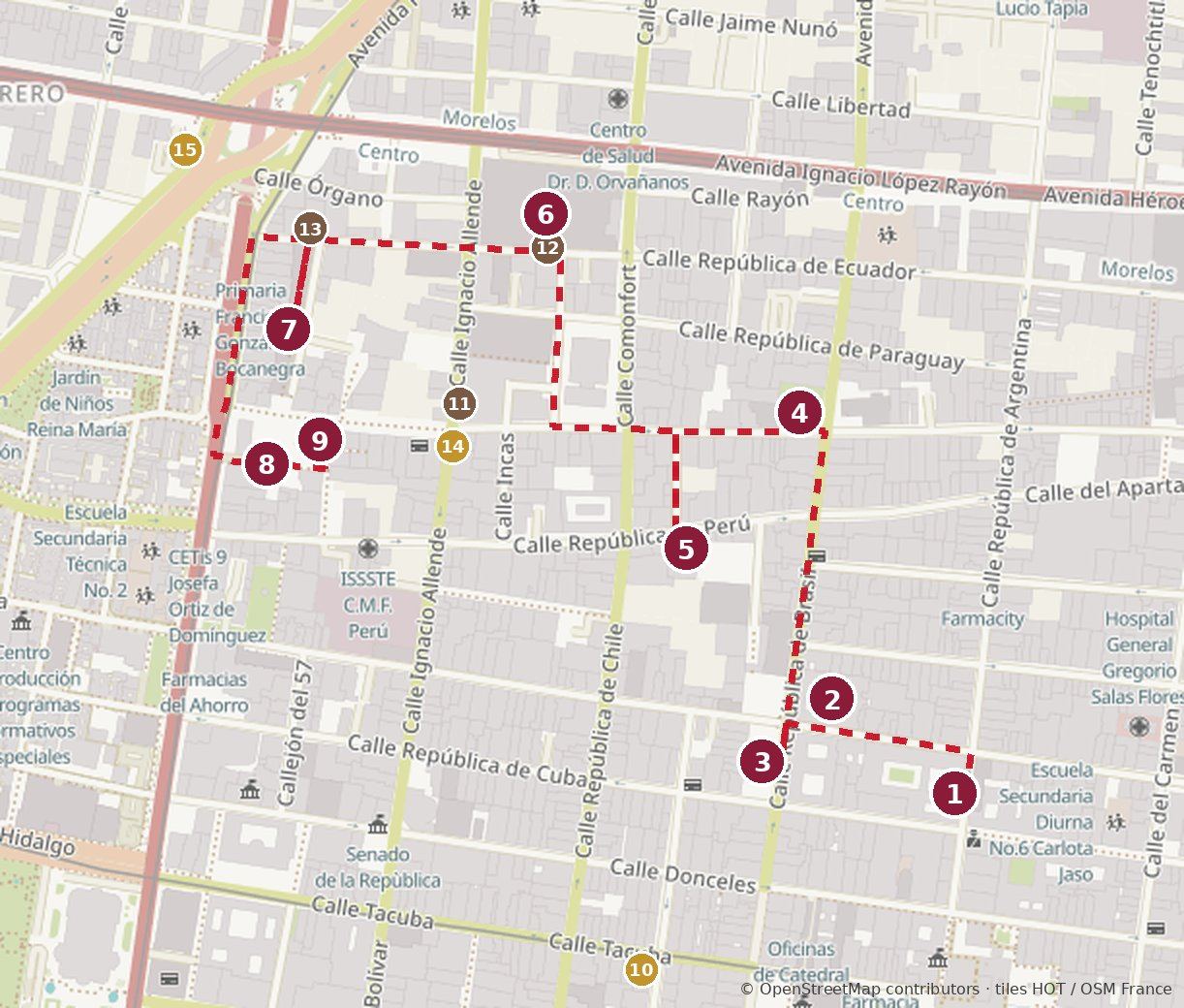
Coffee 11Café Allende · 12Café de los Recuerdos · 13Verdecito Café
Bakeries 10La Vasconia · 14Panadería El Capricho · 15Pastelería Esperanza
Click to enlarge. Map data © OpenStreetMap contributors.
| # | Stop | What it is |
|---|---|---|
| 1 | Museo Vivo del Muralismo | Diego Rivera’s SEP murals |
| 2 | Palacio de la Escuela de Medicina | Inquisition palace, medicine museum |
| 3 | Plaza de Santo Domingo | Plaza of the public scribes |
| 4 | Plaza de Santa Catarina | Lagunilla’s parish plaza |
| 5 | Arena Coliseo | 1943 lucha libre arena |
| 6 | Mercado de La Lagunilla | Clothing and furniture markets |
| 7 | Mercado San Camilito | 24-hour food market |
| 8 | Museo del Tequila y el Mezcal | Museum, bar and terrace |
| 9 | Plaza Garibaldi | The mariachi plaza |
The walk, part 1: the SEP murals to Santo Domingo
The first half is the Centro at its most serious: Rivera’s murals, the Inquisition and the scribes of Santo Domingo.
Start with bread: La Vasconia, Tacuba 73 at Palma (gold circle on the map), daily 6:00–22:00. It is usually called the oldest bakery in the city; nobody has its founding papers, but it was registered as a business in 1870, probably by a Basque baker from the Baztán valley, and in 1900 Andrés Barberena came from Spain to run it. Take a tray and tongs and pick a concha, a campechana or a cuerno, or sit upstairs for breakfast with a view of the street. From here, walk about eight minutes east along Tacuba and Guatemala, behind the Cathedral, and two blocks north on Argentina.
1. Museo Vivo del Muralismo

República de Argentina 28 · Wed–Mon 10:00–17:30, closed Tue · free
This is the Secretaría de Educación Pública, built in the 17th century as the convent of La Encarnación and taken over by the new ministry in the early 1920s. Between 1923 and 1928 Diego Rivera covered its two courtyards with 235 fresco panels, his first big mural job. Since September 2024 the building has been open as a free museum of Mexican muralism, with work by Siqueiros and Roberto Montenegro too. Look for Frida Kahlo handing out rifles on the top floor.
2. Palacio de la Escuela de Medicina

República de Brasil 33, at Venezuela · daily 9:00–18:00; check Mondays · free
Three minutes west, on the corner of Santo Domingo, is the palace Pedro de Arrieta built for the Inquisition in 1732–1736. The tribunal was abolished in the early 19th century, and from 1854 the building housed the National School of Medicine. It is now UNAM’s museum of Mexican medicine: 19th-century wax models, an old pharmacy and a herbal medicine room. Some of the skin-disease models are graphic.
3. Plaza de Santo Domingo

República de Brasil, between Venezuela and Belisario Domínguez · open space, free
Next door is the plaza most visitors never reach. On the north side is the church of Santo Domingo, built in pink stone between 1717 and 1736. In the middle is a fountain with a statue of Josefa Ortiz de Domínguez, the heroine of independence. Under the arcade on the west side, the Portal de Evangelistas, scribes still sit at typewriters writing letters and filling in forms, next to small print shops. Some of them will print you anything, including documents they should not. Look, but don’t order a diploma.
The walk, part 2: La Lagunilla to the plaza
The second half crosses La Lagunilla, with lunch on the way, and then spends the late afternoon in and around the plaza.
4. Plaza de Santa Catarina

República de Brasil between Honduras and Nicaragua · church check hours; plaza open 24 hours · free
Walk about six minutes north up República de Brasil. This shady plaza is said to have been part of the old Lagunilla market. The parish church of Santa Catarina was founded in 1586, according to INAH, and the present building dates from 1740. The church was damaged in the 2017 earthquake and is often closed; the plaza is a good place to sit for ten minutes away from the traffic.
5. Arena Coliseo

República de Perú 77 · lucha libre Sat 19:30; box office Sat from 11:00 · check prices on CMLL
Four minutes south-west is “el embudo de La Lagunilla”, the Lagunilla funnel, named for its steep stands. Salvador Lutteroth built it with a lottery prize after the Arena Nacional burned in 1937, and it opened on 2 April 1943 with El Santo on the card. In 1952 El Santo unmasked Black Shadow here in front of more than 5,400 people. CMLL still holds lucha libre on Saturday nights. On other days, admire the facade and plan a Saturday.
Lunch: Carnitas Zacapu, Callejón de Vaquitas 34, four minutes north-west on the way to the market, Mon and Wed–Fri 10:45–16:30, Sat 10:15–16:30, Sun 9:40–16:00, closed Tue. Zacapu is a town in Michoacán, and this stand does Michoacán-style carnitas: pork cooked in its own fat, sold by the cut. Ask for the tacos achicalados, which the city tourism office singles out. Come before 15:00 or they may be out of the good parts. On a Tuesday, eat at Las Famosas de Cuba instead (República de Cuba 68, two blocks west of Santo Domingo), for carnitas tacos, flautas and tepache.
6. Mercado de La Lagunilla

República del Ecuador at Comonfort, and Juan Álvarez at Allende · Mon–Sat 10:00–18:00, Sun 9:00–17:00 · free
Walk about seven minutes north-west. The Lagunilla clothing market was designed in the 1950s by Pedro Ramírez Vázquez, the architect of the Museo Nacional de Antropología, and it has about 1,000 stalls under five domed roofs. Inside are wedding dresses, quinceañera gowns, christening outfits, charro suits and Halloween costumes, in quantities that are hard to believe. The furniture market is a block away at Juan Álvarez and Allende, and Comonfort is lined with furniture shops.
On Sundays the antiques tianguis sets up a few blocks north around Rayón and Comonfort, roughly 9:00 to 15:00. It is worth a morning on its own. Go early, keep to the antiques stalls, and come back the way you went in.
Coffee break: Café Allende, Allende 69 (brown circle on the map), with Panadería El Capricho two doors down at Allende 63 (gold circle). Café de los Recuerdos at República del Ecuador 46 is by the clothing market, and Verdecito Café (Thu–Sun only) does coffee and bagels in a 1930s Art Deco hotel at República del Ecuador 10.
7. Mercado San Camilito

San Camilito 25, behind the north side of the plaza · open 24 hours
Walk about five minutes south-west: south to República de Honduras and west along it, past the old dance halls, into the plaza. The market is just behind its north side. This is the food market the plaza runs on, said to be the only market in the city open around the clock. Rows of fondas serve birria and pozole with table service, at any hour. Vendors will try to seat you; pick the stall with the most locals and the most salsas. It has toilets.
Drinks: Salón Tenampa, Plaza Garibaldi 12 on the north side of the plaza, daily from 13:00 until 2:00, Thu–Sat until 3:00. The Tenampa has been open since 1925 and is the reason the mariachis are here at all. The walls carry murals of the golden-age film stars, and the regulars included José Alfredo Jiménez and Chavela Vargas; Pedro Infante filmed scenes here. Order the house ponche de granada, a pomegranate punch, and let the bands come to your table. A song from a mariachi costs about 200 pesos (~10.50 USD) and from a trio about 100 pesos (~5.30 USD), according to recent visitors. Agree the price first.
For pulque: La Hermosa Hortensia, Callejón de la Amargura 4 on the east side of the plaza, daily 13:00–24:00. A pulquería since 1936, in the alley whose name translates as “Bitterness Lane.” Tiled walls, photos of politicians, and pulque plain or as curados (guava and red fruit are popular). Order a small one first if you have never had pulque. It is cheap, and the patio looks onto the plaza. Check your bill.
8. Museo del Tequila y el Mezcal

Plaza Garibaldi, on the Eje Central side · Sun–Wed 11:00–21:00, Thu 11:00–22:00, Fri–Sat 11:00–24:00 · check price
Across the plaza. MUTEM opened in December 2010 as part of the plaza’s remodeling. The ground floor has a shop; upstairs are displays on agave, distilling and the history of mariachi and the plaza, and a collection of some 400 bottles. Recent visitors say admission includes a small tasting of both. Then go up to the terrace bar for the view of the Centro, with a mezcal, as the light goes.
9. Plaza Garibaldi

Eje Central Lázaro Cárdenas · open space, free
End where you came for. By late afternoon the plaza fills with bands in charro suits waiting for work, along with norteño groups, trios and son jarocho players, all touting for customers in the traffic noise from Eje Central. There are bronze statues of the singers, among them José Alfredo Jiménez and Juan Gabriel, and a garden of agaves. Crowds and prices peak late on weekend nights. For a visitor the right time is dusk: hire one song, stand in the middle of it, and then call your car.
Coffee, food and drink
For bread, go to La Vasconia; for coffee, Café Allende; for lunch, Carnitas Zacapu or San Camilito; for the evening, the Tenampa then the MUTEM terrace.
| Place | What | Where |
|---|---|---|
| La Vasconia | Bread, breakfast | Tacuba 73, before stop 1 |
| Café Allende | Coffee, breakfast | Allende 69, near stop 6 |
| Café de los Recuerdos | Small café | República del Ecuador 46, near stop 6 |
| Verdecito Café | Coffee, bagels in a 1930s Art Deco hotel | República del Ecuador 10, near stop 6 (Thu–Sun only) |
| Panadería El Capricho | Neighborhood bakery | Allende 63, near stop 6 |
| Las Famosas de Cuba | Carnitas tacos, flautas, tepache | República de Cuba 68, near stop 3 |
| Carnitas Zacapu | Carnitas | Callejón de Vaquitas 34, between stops 5 and 6 |
| Mercado San Camilito | Birria, pozole, 24 hours | Stop 7 |
| Salón Tenampa | Cantina, ponche de granada, mariachi | Plaza Garibaldi 12, north side of stop 9 |
| La Hermosa Hortensia | Pulque | Callejón de la Amargura 4, east side of stop 9 |
| Guadalajara de Noche | Restaurant with mariachi and dance shows, from 18:30 | República de Honduras 9, on the plaza |
| Café de Tacuba | Grand old restaurant, since 1912 | Tacuba 28, near La Vasconia |
If you just want a familiar cup, the chains sit at the southern start of the route:
- Cielito Querido at Tacuba 17, a few minutes west of La Vasconia
- Cielito Querido at Eje Central 6, by Bellas Artes
- Starbucks at Madero 42 and at 5 de Mayo 19, both south of La Vasconia
Shops worth the detour
The shopping here is the markets, and they are serious.
- Mercado de La Lagunilla (stop 6): wedding dresses, quinceañera gowns, charro suits and costumes, many made by the stallholders.
- The furniture market at Juan Álvarez and Allende (near stop 6), and the shops on Comonfort.
- The Sunday antiques tianguis (north of stop 6): lamps, toys, silver, old photos, vinyl.
- MUTEM shop (stop 8): tequila, mezcal and crafts.
- Museo Vivo del Muralismo bookshop (stop 1): mural books and prints.
- La Vasconia (Tacuba 73): a bag of pan dulce for the ride home.
Which day to walk
Saturday gets you the most; Tuesday the least. Only the places with limited days are listed below.
| Place | Mon | Tue–Fri | Sat | Sun |
|---|---|---|---|---|
| 1 Museo Vivo del Muralismo | Open | Closed Tue, open Wed–Fri | Open | Open |
| 2 Escuela de Medicina | Check | Open | Open | Open |
| 5 Arena Coliseo | No show | No lucha | Lucha 19:30 | No lucha |
| Carnitas Zacapu (lunch) | Open | Closed Tue, open Wed–Fri | Open | Until 16:00 |
| 6 Lagunilla | Clothing and furniture | Clothing and furniture | Busiest | Plus antiques tianguis |
| 8 MUTEM | Until 21:00 | Until 21:00 (Thu 22:00, Fri 24:00) | Until 24:00 | Until 21:00 |
On a Sunday, start earlier with the antiques tianguis at 9:00, and do Santo Domingo and the murals after lunch.
Keep walking
Garibaldi borders three areas that are worth carrying on into, by day.
West: Santa María la Redonda. Cross Eje Central from the plaza to the church of Santa María la Redonda (Riva Palacio 46), founded in 1524 with a round apse, in the old Cuepopan barrio.
South: Eje Central to Bellas Artes. Walk ten minutes down Eje Central past the closed Teatro Blanquita (Eje Central 16, at Mina) and the little Capilla de la Concepción Cuepopan, the “chapel of the dead”, on Belisario Domínguez. The plaza around it is rough, so look from the corner. Bellas Artes and the Alameda are straight ahead.
North-west: Santa María la Ribera. From Santa María la Redonda it is a short ride west to the Kiosco Morisco. Santa María la Ribera on Foot covers it.
About the author and where to stay
Brian has lived in Roma Norte for about five years and writes the See Mexico City guides. He speaks seven languages and still gets lost on purpose.
When you visit, stay with us at Penthouse El Cielo de Roma in Roma Norte.
Photo credits
Photos via Wikimedia Commons, used under the licenses shown. Numbers match the captions.
- Rivera Murales Patio SEP.JPG, Kgv88, CC BY-SA 3.0
- Ciudad de México – Antiguo Palacio de la Inquisición 7019.JPG, Phyrexian, CC BY-SA 4.0
- Fuente de la Plaza de Santo Domingo.JPG, Omarem, CC BY-SA 3.0
- Plaza de Santa Catarina (Ciudad de México) 01.jpg, ProtoplasmaKid, CC BY-SA 4.0
- Arena Coliseo CDMX 03.jpg, Wotancito, CC BY-SA 4.0
- MercadoLagunillaBldgDF.JPG, Thelmadatter, Public domain
- Mercado San Camilito – Plaza Garibaldi – Mexico 2024.jpg, José Luiz, CC BY-SA 4.0
- Museo del Tequila y el Mezcal.jpg, Armando Olivo Martín del Campo, CC BY-SA 4.0
- Plaza Garibaldi- statue of mariachi player.jpg, Thayne Tuason, CC BY 4.0
Map: drawn from OpenStreetMap data, © OpenStreetMap contributors, Open Database License.
Sources
Hours and prices checked October 2026; confirm before you go.
- Wikipedia: Plaza Garibaldi, Arena Coliseo, Secretariat of Public Education Main Headquarters, Santo Domingo (Mexico City)
- Mexico City tourism: Plaza Garibaldi, Museo del Tequila y el Mezcal, Mercado Lagunilla Ropa y Telas, Mercado La Lagunilla (Sunday tianguis), Palacio de la Escuela de Medicina
- Secretaría de Turismo CDMX: Recorrido en Garibaldi (PDF)
- Salón Tenampa: Historia
- Excélsior: El Salón Tenampa celebra 100 años con su libro conmemorativo
- Time Out México: Museo del Tequila y el Mezcal
- Crónica: El tequila y el mezcal ya tienen su museo
- La Jornada: Es símbolo de lo que somos: Ebrard (Garibaldi reopening, 2010)
- Washington Times / AP: Mexico opening first mariachi school
- El Universal: La noche que sicarios disfrazados de mariachis protagonizaron balacera en Plaza Garibaldi
- Chilango: Balacera en Garibaldi, Teatro Blanquita podría volver a abrir, Historia centenaria de La Vasconia, Santa María la Redonda, Barrios Mágicos en el DF, Lugares del Centro Histórico que ya no existen
- CDMX Secreta: Curiosidades del barrio de la Lagunilla, Museo Vivo del Muralismo
- Expansión: Arena Coliseo, historia del templo de la lucha libre
- ADN40: Las pulquerías más antiguas del Centro Histórico
- Food & Pleasure: La Capilla de los Muertos, Verdecito Café
- N+: Lista de los Barrios Mágicos de la CDMX
- Hours for La Vasconia, Carnitas Zacapu, Tenampa, La Hermosa Hortensia, MUTEM, Santa Catarina and the cafés: Google Maps listings, October 2026