Centro: La Merced on Foot
Why La Merced
La Merced is the oldest market district in Mexico City, and it still feeds a good part of it. It has a 1957 market hall you could lose a morning in, a candy market, a witchcraft market, the oldest house in the city, a Lebanese café on the plaza where the Mexica are said to have seen their eagle, and a 17th-century cloister that the city knocked a church down around.
It sits at the south-east corner of the Centro Histórico, a ten-minute walk from the Zócalo, split between the Cuauhtémoc and Venustiano Carranza boroughs. Its spine is the Anillo de Circunvalación (Eje 1 Oriente), with the market halls on the far side and the old barrio of narrow streets, churches and vecindades between it and Pino Suárez. The walk starts at the Maronite cathedral on República de Uruguay, after Arabic coffee near Regina, crosses the old barrio and ends at the Mercado de Sonora.
It suits people who like markets more than museums and want to see the Centro that works for a living. It is the roughest walk in this series. Circunvalación is crowded, pickpockets are real, the area is one of the city’s tolerated red-light districts, and some corners are run down. Go on a weekday morning, carry little, and be out by about 17:00. Done like that, it is one of the most rewarding walks in the city.
Practical basics
The walk is about 2.9 km, one way, and takes a morning and early afternoon. Take an Uber or taxi to the start and home from the end. Do it on a weekday.
| Start | Catedral de Balvanera (San Charbel), República de Uruguay 132, at Correo Mayor. For coffee first, start 12 minutes west at Jekemir, Regina 7 |
| Finish | Mercado de Sonora, Fray Servando Teresa de Mier 419 |
| Distance | About 2.9 km; roughly 40 minutes of pure walking, plus about 12 minutes if you start at Jekemir |
| Time needed | 3–4 hours with coffee, the markets and lunch |
| Best day | Monday to Friday, when Casa Talavera and Manzanares 25 are open and the market is at full strength |
| Avoid | Sunday: Jekemir, Café Bagdad, La Zamorana, Casa Talavera and Manzanares 25 are closed and the market shuts at 14:00. Avoid late afternoons on any day |
| Toilets | Buy something: Jekemir, Al Andalus and Café Bagdad all have them |
If you use public transport, Metro Isabel la Católica (Line 1) is a few minutes’ walk from Jekemir. Metro Merced (Line 1) comes up beside the market at stop 10, and Metrobús Line 4 stops at the Mercado de Sonora at the finish.
Start at about 9:30. If you are short of time, skip the Alhóndiga and Manzanares 25 and walk straight from the cloister to the candy market; it saves about ten minutes. If you prefer to start with the markets while they are busiest, do the walk in reverse from Sonora and end with a late lunch at Al Andalus.
The safety rules are simple. Keep your phone in a front pocket and your camera on a strap, and carry small bills. On Circunvalación, keep to the market side of the sidewalk and keep moving. Women work the street along Circunvalación and in some side streets, including Manzanares; be polite and don’t photograph them. Skip the Plaza de la Soledad and the streets north-east of the market beyond Circunvalación. Plaza de la Aguilita is pleasant in the morning and feels rougher after about 17:00. Cross Fray Servando Teresa de Mier only at the lights, and call your car from the front of the Mercado de Sonora.
A short history
La Merced is older than the Spanish city. The Mexica settled here more than 700 years ago, in the district called Teopan, and tradition places here the sign that told them where to build: an eagle on a cactus. There was a shrine to Ehécatl, the wind god, and a pulque brewery. Canals brought goods in by canoe, and the canoes kept coming for centuries. Calle de Roldán was called the Calle del Embarcadero, the landing, until 1928.
In colonial times this was where the city stored and sold its grain, at the Alhóndiga, and collected its church tithes, at the Casa del Diezmo next door. The Mercedarian friars arrived in 1593 and began their convent in 1594, and the cloister was finished in 1703. Under the Reform Laws the convent was broken up, the church was gone by late 1862, and the city put a market on its site. The traders of the old Volador market near the Zócalo were moved here, and a market hall followed under Porfirio Díaz in 1890.
In the early 20th century Lebanese immigrants, fleeing the Ottoman wars, came through Veracruz and opened textile shops, notions stores and groceries on Venustiano Carranza, Jesús María and República de El Salvador. Their Maronite cathedral is still on Uruguay, Jekemir has been roasting coffee since 1938, and the Café Bagdad is still on the Aguilita.
On 23 September 1957 President Adolfo Ruiz Cortines opened the present Mercado de La Merced, designed by Enrique del Moral and one of the largest markets in Latin America. The Mercado de Sonora opened the same year. Then in the 1980s the new Central de Abasto in Iztapalapa took over the wholesale trade, families moved away, and the 1985 earthquake did the rest. The barrio became known for poverty, robbery and sex work, with an estimated 800 to 1,200 sex workers today.
Renewal has come in pieces. The Alhóndiga–Talavera pedestrian corridor opened in the 2000s, and about 100 million pesos went into streets, facades and the Plaza Alonso García Bravo between 2009 and 2012. In 2018 the restored Manzanares 25, believed to date from about 1580, opened as a children’s cultural center. Fires gutted much of the market’s main hall in February 2013 and again on 24 December 2019, when two people died, and the hall has been rebuilt in stages since. La Merced is one of Mexico City’s Barrios Mágicos.
The route
The walk runs one way, from the Maronite cathedral on República de Uruguay east through the old barrio to the market halls on Circunvalación and south to the Mercado de Sonora, in 11 numbered stops. Have your coffee at Jekemir on Regina before you start. Follow it on the La Merced on Foot map, which shows every stop, the walking route, coffee places and bakeries, and the nearest chain cafés.
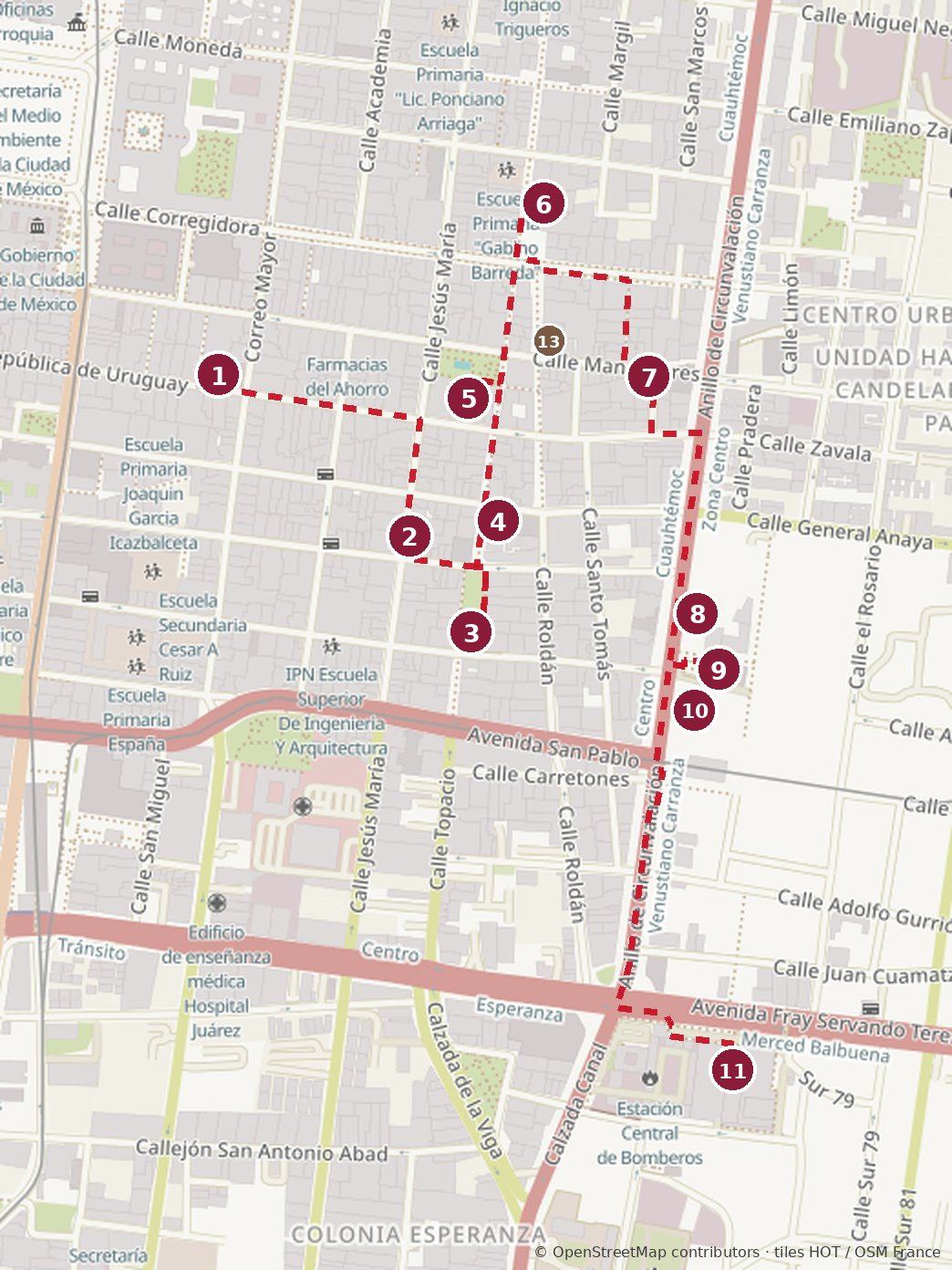
Coffee 12El Nuevo Café Bagdad · 13Café X
Click to enlarge. Map data © OpenStreetMap contributors.
| # | Stop | What it is |
|---|---|---|
| 1 | Catedral de Balvanera (San Charbel) | Maronite cathedral |
| 2 | La Zamorana | Paper decorations shop |
| 3 | Plaza de la Aguilita | Founding-legend plaza |
| 4 | Casa Talavera | Colonial house, cultural center |
| 5 | Claustro de La Merced | 17th-century cloister |
| 6 | Alhóndiga and Casa del Diezmo | Colonial granary and canal bridge |
| 7 | Manzanares 25 and the Señor de la Humildad | Oldest house, tiny chapel |
| 8 | Mercado de Dulces | Candy market |
| 9 | Santo Tomás la Palma | Market parish church |
| 10 | Mercado de La Merced | The great market hall |
| 11 | Mercado de Sonora | Herbs, pottery and witchcraft |
The walk, part 1: Uruguay to the cloister
The first half is the old Lebanese quarter and the colonial barrio: a cathedral, paper flags and the plaza of the eagle.
Coffee first: Jekemir Café (Regina 7, Mon–Sat 8:00–21:00), Lebanese-Mexican since 1938. Order the café árabe and the pastel de elote. From there, walk two blocks north to República de Uruguay and follow it east about 12 minutes, across Pino Suárez, to Correo Mayor.
1. Catedral de Balvanera (San Charbel)

República de Uruguay 132, at Correo Mayor · check hours · free
The convent here was founded in 1573 as Santo Niño Perdido and rebuilt in 1667 as Balvanera. It is a Baroque church with its main door on the side, a tezontle facade and a bell tower covered in Puebla tiles. Today it is the cathedral of Mexico’s Maronite Catholics. Inside, the statue of San Charbel, the Lebanese monk, is dressed in colored ribbons that the faithful buy in the notions shops on the street outside.
Food note: Al Andalus (Mesones 171, daily 9:00–18:00), the Lebanese lunch of the Centro, is on the way to the next stop. Too early to eat? Mark it for the end of the day.
2. La Zamorana
Jesús María 112 · Mon–Sat 11:00–18:45, closed Sun
Walk about five minutes south and east to Jesús María. La Zamorana, Tienda de Maravillas, sells papel picado, crepe paper, flags and decorations for every feast in the Mexican calendar. Gabriel García Márquez visited in 1992 and left a dedication. The shop is small and packed; ask for prices, because nothing is labeled.
3. Plaza de la Aguilita

Plaza Juan José Baz · open space · free
Three minutes south-east is the plaza everyone calls La Aguilita, the little eagle. Its official name honors Juan José Baz, a reform-era liberal politician. On top of the column is a bronze eagle on a nopal eating a serpent, the emblem on the Mexican flag, because legend says this is where the Mexica saw it. An anthropologist told La Crónica the site can be neither confirmed nor ruled out. In 2000 the city added planters tiled with the 42 coats of arms the country has used.
Coffee break: El Nuevo Café Bagdad (Plaza Juan José Baz 4), on the plaza itself, roasts its coffee on site. Mon–Sat 8:00–18:00. Brown circle on the map.
4. Casa Talavera

Talavera 20, at República de El Salvador · Mon–Fri 9:00–19:00, closed weekends · free
Walk three minutes north up Talavera. On the way, look in at the Callejón del Niño Dios, where workshops like Niños Uribe (No. 9) dress Christ-child figures for their owners; in 2020 some came out in pandemic outfits. Casa Talavera is a colonial mansion with three courtyards that once made Talavera pottery and later held a tannery. It is now a cultural center of the city university (UACM), with a small site museum, finds from pre-Hispanic to modern times, and an archaeological window in the floor.
5. Claustro de La Merced
República de Uruguay 170, at Talavera · exterior; occasionally open, check · free
Three minutes on, at the corner of Uruguay, is the last piece of the Mercedarian convent. The cloister was built between 1676 and 1703 and is known for its Mudéjar style; the church beside it was demolished by 1862 to make way for the market. In the early 20th century, when it was threatened again, the painter Dr. Atl moved in to save it, and in 1927 the Escuela Libre de Escultura y Talla Directa opened in its patio. INAH began restoring it in 2007. In recent years it has mostly been closed, so be happy with the facade, and look in if the door is open.
The walk, part 2: the canal to the markets
The second half goes up to the colonial granary, across to the oldest house, and then out to Circunvalación and the market halls.
6. Alhóndiga and Casa del Diezmo

Alhóndiga 10, at Corregidora · exterior only · free
Walk about four minutes north along the pedestrian Alhóndiga street, past the Plaza Alonso García Bravo. The old grain exchange and the tithe house stand together, and in front of them is a small stone bridge over a surviving stretch of the Acequia Real, the colonial canal that once brought canoes into the city. INAH keeps the buildings closed, and street vendors crowd the bridge. Find it anyway; it is one of the few places in the Centro where you can still see where the water ran.
Coffee break: Café X (Roldán 16), a small coffee bar two minutes south of the bridge. Brown circle on the map.
7. Manzanares 25 and the Señor de la Humildad

Manzanares 25 (house) and Manzanares 32 (chapel) · house Mon–Fri, check hours; chapel daily 10:00–18:00 · free
Five minutes south-east, on Calle Manzanares, is what the Fideicomiso del Centro Histórico calls the oldest house in the city: one story, twelve rooms around a courtyard, believed to date from about 1580. It took eight years to restore with INAH, and since 2018 it has been a cultural center for children from La Merced, Tepito and La Candelaria, with a small museum. Not everyone accepts that it is the oldest; an urban anthropologist told KJZZ it looks like a later house. Across the street is the chapel of the Señor de la Humildad, so small it holds about 20 people, so Mass is said in its tiny plaza.
Drink stop: Pulquería El Recreo (Manzanares 1), at the west end of the street, has served pulque for more than 80 years. Before dark only.
8. Mercado de Dulces

Anillo de Circunvalación, north of the main market · daily 8:30–18:00
Walk east to Circunvalación and turn right along the market side for about five minutes. This is the edge of La Merced: carts, crowds, street stalls and women working the avenue. The candy market is a warehouse of giant lollipops, candied fruit, marshmallows in every color and regional sweets, sold by the kilo. Watch your bag here; the bees come for the sugar, and the pickpockets for the tourists.
9. Santo Tomás la Palma

Misioneros 12 · check hours · free
Two minutes south, almost hidden behind stalls, is the parish church of the old La Palma barrio. It was probably founded by the Augustinians in the 16th century, and the present church was begun in 1728, with vaults added in the 19th century. Vendors stop in before work to ask for good sales, and outside, whole families sit making up bags of sweets to sell.
10. Mercado de La Merced

Anillo de Circunvalación at General Anaya and Rosario · Mon–Sat 5:30–18:00, Sun 5:30–14:00 · free
Two minutes on is the main entrance to the Nave Mayor, next to the church. Mexico News Daily counts seven buildings on 88,000 square meters with room for 5,525 merchants, second in size only to the Central de Abasto. Inside are produce, chiles, meat, housewares and things you will not identify. Floors are slick and handcarts don’t stop, so keep to the side.
Lunch: the 200-meter row of stalls along General Anaya, for chicken and seafood caldos, huaraches and quesadillas. Or the covered Mercado de Comidas at Rosario 104, with dozens more kitchens, daily 4:00–17:00.
11. Mercado de Sonora

Fray Servando Teresa de Mier 419 · Mon–Sat 9:00–19:00, Sun 9:00–17:00 · free
Walk about eight minutes south through the market streets and cross Fray Servando at the lights. The Sonora opened in 1957 and sells pottery (much of it from Guanajuato), toys, piñatas, costumes and Day of the Dead goods. Its fame is the back half: medicinal herbs, candles, amulets and stalls offering limpias, ritual cleansings. There is also a live animal section. Some of the species sold there are endangered, and police have raided it; you may prefer to skip it, and you will smell it either way. Saturday is the busiest day. Call your car from the front on Fray Servando.
Coffee, food and drink
For coffee, go to Jekemir or the Café Bagdad; for lunch, the stalls along General Anaya or Al Andalus; for a drink, Pulquería El Recreo, before dark.
| Place | What | Where |
|---|---|---|
| Jekemir Café | Arabic coffee, corn muffins | Regina 7, before stop 1 |
| El Nuevo Café Bagdad | Coffee roasted on site, breakfast | Plaza Juan José Baz 4, stop 3 |
| Café X | Small coffee bar | Roldán 16, near stop 6 |
| Café Real Rentería | Coffee | Isabel la Católica 87, near Jekemir |
| Pastelería Ideal | Huge old-school bakery | República de Uruguay 74, on the way to stop 1 |
| Panificadora San Ciprián | Neighborhood bakery | Cerrada San Ciprián 107, near stop 10 |
| Al Andalus | Lebanese food | Mesones 171, between stops 1 and 2 |
| Tacos Los Paisas | Tacos | Jesús María 131, near stop 3 |
| Roldán 37 | Mexican restaurant upstairs, chiles rellenos | Roldán 37, near stop 4 |
| Mercado de Comidas | Fondas and comida corrida | Rosario 104, near stop 10 |
| McTeo’s | French fry tacos | Puerta 16, inside stop 10 |
| Pulquería El Recreo | Pulque | Manzanares 1, by stop 7 |
Jekemir was founded at the end of the 1930s by a Lebanese immigrant, and Time Out gives the year as 1938. It used to be on Isabel la Católica and is now on the quiet Regina corridor, with tables outside facing the church of Regina Coeli. Spotted by Locals put the café árabe and pastel de elote at about 70 pesos (~3.70 USD) for the pair. They sell beans and Lebanese groceries too. Open Mon–Sat 8:00–21:00, closed Sun.
El Nuevo Café Bagdad is in an 18th-century house with a fountain and a long stained-glass skylight. It dates back more than 75 years, to a cafeteria Lebanese merchants moved here from a sports club, and for decades it was a men-only room. Now everyone comes. Order the huevos a la cazuela árabe, and look for the 1950s mural of the owners and the tiny chapel to San Judas Tadeo at the back. Count on about 120 pesos (~6.30 USD) a head.
Al Andalus (Mesones 171, between Las Cruces and Jesús María, daily 9:00–18:00) is in a colonial house with a quiet courtyard behind the street noise. You eat upstairs in high-ceilinged rooms. Chilango called it nearly 20 years old in 2013. Order a jug of Arabic coffee, falafel, shawarma and the olives, and share.
In the market, McTeo’s, by Puerta 16, claims to have invented the french fry taco. Near Puerta 1 a pre-Hispanic stand sells maguey worms and grasshoppers.
If you just want a familiar cup, the chains sit at the western end, near Jekemir:
- Cielito Querido at 5 de Febrero 53, by Regina
- Cielito Querido at 16 de Septiembre 82
- Starbucks at 16 de Septiembre 79
Shops worth the detour
La Merced is all shopping, most of it wholesale. These are the ones worth carrying home.
- La Zamorana (stop 2): papel picado, paper flags and decorations for every holiday.
- Mercado de Dulces (stop 8): Mexican candy by the kilo, and candied fruit.
- Mercado de Sonora (stop 11): clay pots, piñatas, herbs and candles.
- Mercado de La Merced (stop 10): dried chiles, spices and cheap kitchen tools.
- Jekemir (Regina 7, before stop 1): coffee beans and Lebanese groceries.
- The notions shops on República de Uruguay (around stop 1): ribbons, buttons and trimmings.
Which day to walk
A weekday gets you the most; Sunday the least. Only the stops with limited days are listed below.
| Stop | Mon | Tue–Fri | Sat | Sun |
|---|---|---|---|---|
| 2 La Zamorana | Open | Open | Open | Closed |
| 4 Casa Talavera | Open | Open | Closed | Closed |
| 7 Manzanares 25 | Open | Open | Closed | Closed |
| 10 Mercado de La Merced | Open | Open | Open | Until 14:00 |
| 11 Mercado de Sonora | Until 19:00 | Until 19:00 | Busiest, until 19:00 | Until 17:00 |
Jekemir and the Café Bagdad are also closed on Sunday. If Saturday is your only day, start at 9:00, accept that Casa Talavera and Manzanares 25 are exterior only, and you still get everything else.
Keep walking
La Merced borders three areas that are worth carrying on into, by day.
North-west: the Zócalo and Templo Mayor. From the Balvanera (stop 1), Correo Mayor leads north into the Centro; the Zócalo is about ten minutes away. Centro on Foot covers it.
North: La Santísima. Two minutes north of the Alhóndiga (stop 6), on Emiliano Zapata, is the Baroque church of La Santísima Trinidad, with murals on the walls of the street beside it.
South: Jamaica. The Mercado de Jamaica, the city’s flower market, is a short ride south from the Sonora. Jamaica on Foot covers it.
About the author and where to stay
Brian has lived in Roma Norte for about five years and writes the See Mexico City guides. He speaks seven languages and still gets lost on purpose.
When you visit, stay with us at Penthouse El Cielo de Roma in Roma Norte.
Photo credits
Photos via Wikimedia Commons, used under the licenses shown. Numbers match the captions.
- Santuario de San Charbel, Ciudad de México.jpg, Catedrales e Iglesias/Cathedrals and Churches, CC BY 2.0
- Plaza de la Aguilita (columna).JPG, Angelina Cruz Rodríguez, CC BY-SA 3.0
- Casa Talavera 04.jpg, ProtoplasmaKid, CC BY-SA 3.0
- Alhondiga ciudad de mexico.jpg, Mexch, CC BY-SA 3.0
- Manzanares 25 – Calle Manzanares – Mexico 2024.jpg, José Luiz, CC BY-SA 4.0
- Mercado de dulces de la Merced.JPG, Gacelita, CC0
- Facade – Santo Tomás la Palma – La Merced – Mexico 2024 (3).jpg, José Luiz, CC BY-SA 4.0
- Hall2MercedDF.JPG, Thelmadatter, CC BY-SA 3.0
- Mercado de Sonora (3980635182).jpg, Carlos Adampol Galindo, CC BY-SA 2.0
Map: drawn from OpenStreetMap data, © OpenStreetMap contributors, Open Database License.
Sources
Hours and prices checked October 2026; confirm before you go.
- Wikipedia: La Merced (neighborhood), Convent of La Merced, Mexico City, Mercado de Sonora, Valvanera Cathedral
- Mexico City tourism: La Merced Cloister, Templo de Santo Tomás la Palma, Mercado de Comidas La Merced
- Mexico News Daily: How to find your way through the massive Mercado de la Merced
- Uno TV: El Mercado de la Merced cumple 63 años
- Expansión: La reconstrucción de los mercados de La Merced y San Cosme enfrenta retrasos
- Chilango: Historias y leyendas de La Merced, Plaza de la Aguilita, Los secretos del Nuevo Café Bagdad, Líbano en La Merced, Barrios Mágicos en el DF
- CDMX Secreta: Café Bagdad
- Time Out México: Jekemir, Claustro del Ex Convento de la Merced
- Spotted by Locals: Café Jekemir
- Local.mx: Claustro del Ex Convento de Nuestra Señora de la Merced
- KJZZ: Mexico City’s oldest house
- Food & Pleasure: La casa más antigua de la CDMX
- ADN40: Las pulquerías más antiguas del Centro Histórico
- TV Azteca: La calle de la Ciudad de México que nunca deberías recorrer sin compañía
- N+: Lista de los Barrios Mágicos de la CDMX
- Hours for Jekemir, Al Andalus, La Zamorana, Café Bagdad, Casa Talavera, the Señor de la Humildad, the markets and the cafés: Google Maps listings, October 2026