Far Southeast: Mixquic on Foot
Why Mixquic
San Andrés Mixquic is the village most people in Mexico City know from one night a year. On 2 November its cemetery, which still sits in the churchyard, fills with candles, marigolds and copal smoke, and thousands of visitors come to watch. The other 364 days it is a farming town of chinampas, four barrio chapels, a 16th-century Augustinian church and a market where the vegetables come from a few hundred meters away.
It is far. Mixquic sits at the south-eastern tip of the city in the borough of Tláhuac, on what used to be an island in Lake Chalco, about 30 km from Roma Norte as the crow flies. By car it is roughly an hour each way, more in traffic. The town itself is small and flat. You can cross the center in ten minutes.
This walk suits people who have seen Xochimilco and want the quieter end of the lake country, and anyone curious about Día de Muertos outside the fiesta. It is not pretty everywhere. The road in from Tetelco is a plain two-lane highway, some streets are bare cinder block, and on a weekday afternoon very little happens. Go for the church, the cemetery, the chinampas and lunch.
Practical basics
The walk is about 3 km, one way, and takes a morning. Take an Uber or taxi to the start in San Nicolás Tetelco and home from the market. Go on a Saturday.
| Start | Pan Casero El Horno (bakery), Carretera Mixquic–Chalco 20, San Nicolás Tetelco; stop 1 is three minutes away |
| Finish | Mercado Mixquic, Canal Seco at 20 de Noviembre |
| Distance | About 3 km; roughly 40 minutes of pure walking |
| Time needed | 3 hours with the museum, the convent patio and lunch |
| Best day | Saturday: the museum, the convent patio, the pozolería and the boats should all be working |
| Avoid | Monday, when the museum and the tianguis are closed; 1–2 November unless the fiesta is the point |
| Toilets | Buy something: Xólotl Café and the market have them |
There is no rail station near Mixquic. The closest is Metro Tláhuac, the end of Line 12, about 9 km away; from there buses run to the village, and a taxi takes a little under 40 minutes. From Metro Taxqueña (Line 2) RTP buses also make the trip, but it takes two hours or more.
If you are short of time, skip Tetelco (the bakery and stop 1) and start at the embarcadero (stop 2). That cuts more than a kilometer, most of it beside traffic. The stretch from Tetelco to Mixquic runs along the Mixquic–Chalco road: walk facing the traffic and keep to the shoulder.
Mixquic is a quiet village and feels safe in daylight. Carry cash in small notes, because almost nothing takes cards. Getting a ride back can take a while out here, so call your Uber before you finish lunch.
The Day of the Dead crowds
The fiesta runs from about 29 October to 2 November, and 2 November is the big night. Families light the candles on the graves around 18:30, the church bells ring about half an hour later, and the cemetery stays lit until about midnight. Time Out counted around 15,000 visitors over four days, and city tourism says most visitors cannot get into the cemetery after 22:00 on the 2nd. Roads are jammed and prices go up. Go with a tour or arrive by early afternoon, and remember that the people at the graves are visiting their own dead. This guide describes an ordinary day.
A short history
Mixquic began as an island in Lake Chalco. Chichimecas, Chalcas and Cuitlahuacas settled it around 1168, and for most of its history people lived from fishing and from chinampas, the raised fields built up out of the lake mud. The name is usually translated as “place of the mesquite”, although some researchers link it to miquiztli, death. Xochimilco, Azcapotzalco and then Tenochtitlan took turns ruling it, and the Mexica conquered it in 1433.
The Augustinians arrived in 1536 and began the church of San Andrés Apóstol on top of the village’s teocalli, its pre-Hispanic temple platform. They chose Saint Andrew, the fisherman, for a fishing town. The first church was finished in 1563. An earthquake brought it down, leaving only its bell tower, and the present church went up afterwards; its facade dates from about 1620. The complex was declared a historic monument in 1932.
The village grew around the church in four barrios, each with its chapel and stone cross: San Miguel to the south-east, San Agustín to the south-west, Los Reyes to the north-west and San Bartolomé to the north-east. The crosses still mark them, and some carry dates from 1887 and 1928.
Then the lake went. Drainage of Lake Chalco began in the second half of the 19th century and was finished under Porfirio Díaz. In 1898 Mixquic was brought under Mexico City’s control, and with it its water. By the 1960s the wells could no longer keep the chinampas wet, and the canoe trade died. What survives is a smaller zone of canals and fields that still makes Mixquic the city’s main vegetable garden.
In 2011 the city named Mixquic one of its Barrios Mágicos, with the idea of bringing visitors outside 1 and 2 November. That part has not really worked. The Día de Muertos has only grown: the first calaveritas contest, with skulls of wire and paper, was held in 1943 and still takes place every year.
The route
The walk runs one way, from Tetelco north along the old lake road into Mixquic, past the chinampas, round the four barrio chapels and into the center, ending at the market, in 12 numbered stops. It starts with bread in Tetelco, and bakeries and a café fall along the way. Follow it on the Mixquic on Foot map, which shows every stop and the bakeries and cafés nearby.
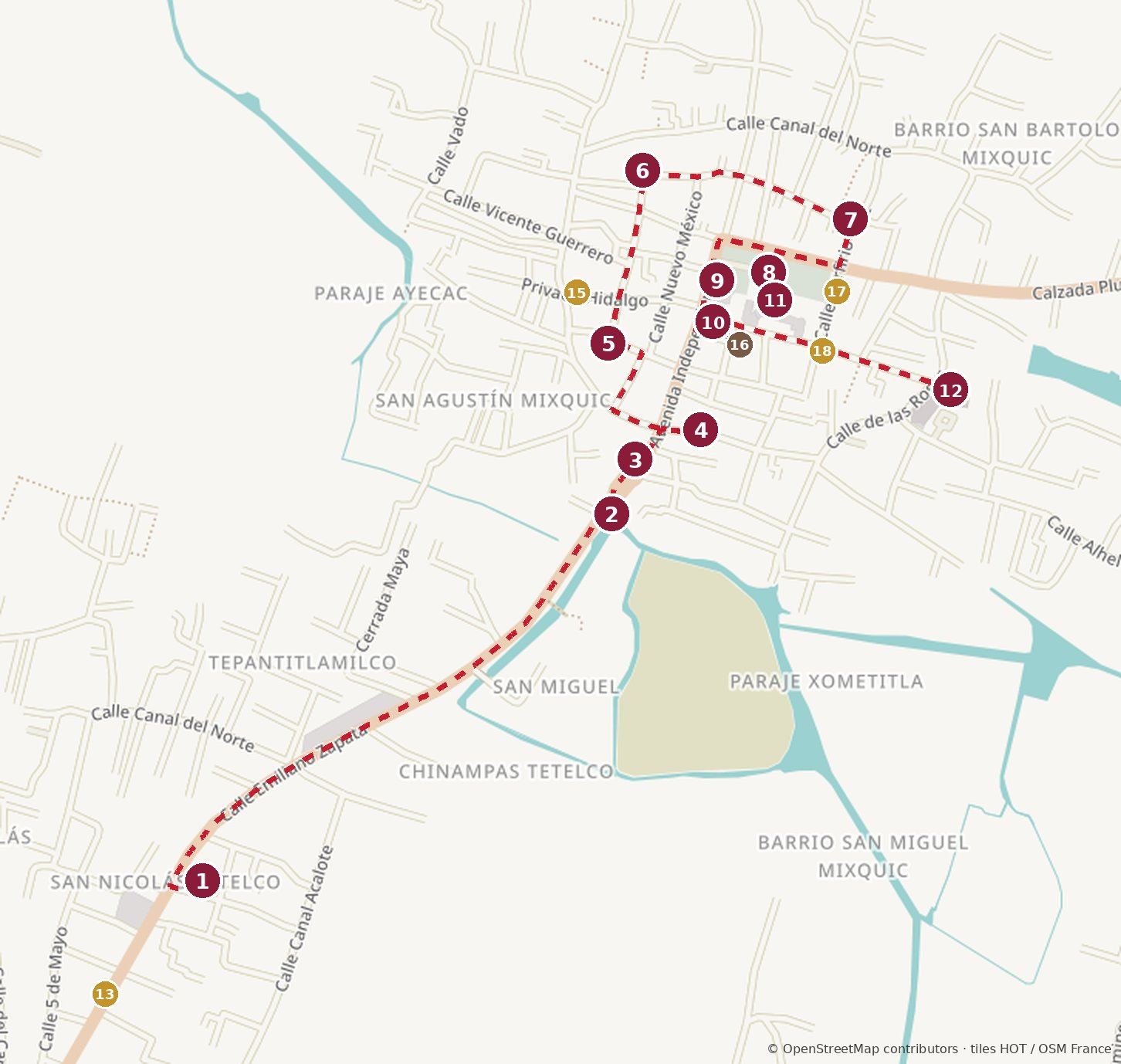
Coffee 14Xólotl Café · 16Drink's Twins
Bakeries 13Pan Casero El Horno · 15Panadería Estelita · 17Pastelería Annie · 18Panadería Mizquitl
Click to enlarge. Map data © OpenStreetMap contributors.
| # | Stop | What it is |
|---|---|---|
| 1 | Parroquia de San Nicolás Tolentino | Tetelco’s parish church |
| 2 | Embarcadero Míxquic | Boat landing and chinampas |
| 3 | Teatro Miquiztli | Village theater |
| 4 | Capilla de San Miguel | Barrio chapel and cross |
| 5 | Capilla de San Agustín | Barrio chapel and 1887 cross |
| 6 | Capilla de los Santos Reyes | Barrio chapel, 1928 cross |
| 7 | Capilla de San Bartolomé | Barrio chapel, slender tower |
| 8 | Parroquia de San Andrés Apóstol and the cemetery | Church and atrium cemetery |
| 9 | Museo Andrés Quintana Roo | Archaeology museum and library |
| 10 | Plaza Juárez | Main square and kiosk |
| 11 | Exconvento de San Andrés | Cloister and pre-Hispanic stones |
| 12 | Mercado Mixquic | Market and lunch counters |
The walk, part 1: Tetelco to the barrio chapels
The first half follows the old lake road from Tetelco to the boat landing, then loops through three of the four barrios on the western side of the village.
Breakfast: start with bread at Pan Casero El Horno (Carretera Mixquic–Chalco 20, San Nicolás Tetelco, daily 8:00–22:00; gold circle on the map), a neighborhood panadería in Tetelco, Mixquic’s smaller neighbor. Conchas, teleras, chocolate muffins. Buy something to carry; the next bakery is almost two kilometers away.
1. Parroquia de San Nicolás Tolentino
Carretera Mixquic–Chalco, San Nicolás Tetelco · Mon–Fri 10:00–14:00 and 15:30–18:00, Sat 10:00–14:00; check hours · free
From the bakery, walk three minutes north-east to the church on the little plaza. Tetelco is one of the original villages of Tláhuac and keeps its own Día de Muertos, with altars that get a fraction of Mixquic’s crowds. The church is small and well kept inside. If it is shut, the plaza is still a good quiet start.
2. Embarcadero Míxquic
Tetelco 4, Barrio San Agustín · check hours; boats mostly weekends and Día de Muertos · price not posted, ask first
Now the long leg: about 12 minutes north along the road into Mixquic. On the left you start to see the chinampas. Mixquic and San Pedro Tláhuac share the largest chinampa zone in the borough, about 500 hectares at Mixquic, and the fields send spinach, romeritos, celery, lettuce and beet to the Central de Abastos every day. The whole lake zone of Xochimilco, Tláhuac and Milpa Alta has been on UNESCO’s World Heritage list since 1987.
The embarcadero is where the boats go out on what is left of the canals. In late October and early November the chinampas around it are planted with marigolds, the boats are decorated, and a storyteller rides along while La Llorona appears on the bank. The rest of the year it is quieter and sometimes empty. Agree the price before you get in.
3. Teatro Miquiztli
Av. Independencia s/n, Barrio San Agustín · shows vary; check hours
One minute on is the small village theater, named for the Nahuatl day sign of death and used mostly by the children’s cultural center.
Coffee break: Xólotl Café, right next to the theater (brown circle on the map), serves coffee and quesadillas at street tables, daily 8:00–22:30. Ask the price before you order.
4. Capilla de San Miguel
Abasolo 16, Barrio San Miguel · check hours · free
Two minutes east is Barrio San Miguel, whose saint’s day is 29 September. Its stone cross stands in front, with a modern chapel, the Señor de los Milagros, behind it.
Pozole for later: at the same address the family-run Pozolería San Miguel opens on weekends (Sat–Sun 10:00–22:00): pozole with extra broth if you ask, chilaquiles and tacos dorados, at village prices. It is early for lunch, but note it.
5. Capilla de San Agustín
José María Morelos 28, Barrio San Agustín · check hours · free
Walk about four minutes north-west. San Agustín celebrates on 28 August, when its little chapel is covered in flowers. The barrio cross is dated 3 May 1887, the day of the Holy Cross. The chapel has lost most of its original decoration, but it is on every local’s route of the crosses, the Sendero de las Cruces, walked at Easter and Corpus Christi.
Bread: two minutes north on Hidalgo, Panadería Estelita (Av. Hidalgo 17; check hours; gold circle on the map) is a family bakery that still uses a stone oven more than 80 years old. Old-fashioned bread from old recipes. Mexico Desconocido also points out carved anthropomorphic stones on Hidalgo at the corner of Nuevo México; look for them on the way.
6. Capilla de los Santos Reyes
Insurgentes at Emiliano Zapata, Barrio Los Reyes · check hours · free
Carry on north up Hidalgo, about three minutes in all from San Agustín, to Los Reyes, the north-western barrio, whose fiesta is on 6 January. Its cross is dated 3 May 1928 and has a chapel of its own.
The walk, part 2: San Bartolomé to the market
The second half crosses to the last barrio chapel and then takes in the center: the church and cemetery, the museum, the square and the convent patio, ending with lunch at the market.
7. Capilla de San Bartolomé
Insurgentes at Porfirio Díaz, Barrio San Bartolomé · check hours · free
Walk about four minutes east along Insurgentes. San Bartolomé, the north-eastern barrio, has the best-looking of the four chapels, with a tall, slender tower, and its fiesta is on 24 August. On the Day of the Dead it puts up one of the largest ofrendas in town.
8. Parroquia de San Andrés Apóstol and the cemetery

Av. Independencia · mornings, roughly 10:00–14:00 or 15:00; check hours · free
Two minutes south is the reason everyone comes. You enter the church through its cemetery, one of very few left in Mexico City that still fills the old churchyard. The graves are close together, tiled, painted and planted. In the middle is the Altar de los Sacrificios, a tomb topped with bones and skulls, named after the tzompantli, the Aztec rack of skulls. The custom of putting the bones of emptied graves on display stopped because people kept stealing them.
The church has three naves and a wooden door that keeps its original nails and brass fittings. Saint Andrew on the altarpiece holds a fish. Look for the Señor de las Maravillas, a Christ made of corn-stalk paste, with jointed limbs, real hair and its original brass crown. The clock on the front is dated May 1930. If Mass is on, keep quiet.
9. Museo Andrés Quintana Roo
Av. Independencia at Perú · Tue–Sun 10:00–18:00 · free
Two minutes west, across the corner, is the town library and, upstairs, the museum. It opened in 1992 with 279 pieces found in and around Mixquic, donated by local researcher Socorro Bernal Roque, most of them clay and stone from the late Postclassic period (1200–1500). There is a chac mool, a coiled serpent, clay and stone seals and a calendar carved into a baptismal font. Sign the visitors’ book at the door. It is small and has very little explanation; fifteen minutes is enough. One visitor found it closed for lunch between 14:00 and 15:00.
The museum is named for Andrés Quintana Roo, the 19th-century liberal lawyer married to the independence heroine Leona Vicario. Behind it, on Medellín, a small tianguis sells food Tuesday to Sunday until about 16:00.
10. Plaza Juárez
Av. Independencia, in front of the church · open space · free
One minute away is the square, with its kiosk, the borough office and stands for elote and ice cream. The wire-and-paper skulls from the yearly calaveritas contest are displayed on a wall here, and the Day of the Dead concerts play here too. Sit for a few minutes and look at the church.
Coffee break: Drink’s Twins, by the square (brown circle on the map), does coffee, snacks, desserts and board games, Friday to Sunday from the afternoon. Pastelería Annie (Josefa Ortiz de Domínguez 11, gold circle on the map) is a couple of minutes east for cake.
11. Exconvento de San Andrés

Popocatépetl at Av. Independencia · Mon–Sat 9:00–17:00, closed Sun; check hours · free
Two minutes back towards the church, through the three tezontle arches beside it, is the old Augustinian convent. Its walls are 90 cm thick. The cloister keeps twelve columns, and the corridors have round arches on Tuscan columns. The free-standing bell tower is all that is left of the first church.
The patio of the priest’s house is the strangest garden in the city. Pieces of the teocalli the church was built on stand among the plants: a chac mool between two rings from a ball court, columns carved with Quetzalcoatl, and a figure of Mixquixtli, goddess of life and death, with one face alive and one dead. Ask whoever is at the door if the patio is not open.
Bread for the road: on the way to the market, one minute south-east, Panadería Mizquitl (20 de Noviembre 12, daily 6:30–22:00; gold circle on the map) is the village bakery. Country bread, teleras that taste nothing like the city’s, sweet bread that is not too sweet, and mocha donuts. Around late October it sells pan de muerto, at about twice the price of the regular bread.
12. Mercado Mixquic
Canal Seco at 20 de Noviembre · daily 8:00–19:00
About four minutes from the convent is the market, small and not much to look at, with fruit, vegetables, meat, cheese and a candy stall at number 100.
Lunch: the market’s lunch counters do gorditas de frijol, guisados and a cheap three-course comida corrida. Ask around for mixmole, the local mole with charales and nopales, a dish from the lake days. You will most likely find it around the fiestas. The alternative is back on the square: Restaurante campestre La Gran Kermesse (Plaza Juárez 2, Wed–Sun) does burgers, birria and coffee. When you are done, call your ride from the corner.
Coffee, food and drink
For coffee, go to Xólotl Café; for lunch, the market or, on weekends, Pozolería San Miguel; for bread, Estelita and Mizquitl.
| Place | What | Where |
|---|---|---|
| Xólotl Café | Coffee, quesadillas | Next to stop 3 |
| Pozolería San Miguel | Pozole, chilaquiles, tacos dorados (weekends) | Abasolo 16, at stop 4 |
| Mercado Mixquic | Comida corrida, gorditas, guisados | Stop 12 |
| Tianguis Mixquic | Street food, quesadillas | Medellín, behind stop 9 (Tue–Sun 8:00–16:00) |
| Restaurante campestre La Gran Kermesse | Burgers, birria, coffee | Plaza Juárez 2, by stop 10 (Wed–Sun) |
| Drink’s Twins | Coffee, snacks, desserts, board games | By Plaza Juárez (Fri–Sun from the afternoon) |
| Pan Casero El Horno | Bakery | Carretera Mixquic–Chalco 20, Tetelco, the start |
| Panadería Estelita | Bakery, stone oven | Av. Hidalgo 17, between stops 5 and 6 |
| Panadería Mizquitl | Bakery | 20 de Noviembre 12, between stops 11 and 12 |
| Pastelería Annie | Cakes | Josefa Ortiz de Domínguez 11, near stop 8 |
| Panadería La Bartola | Bakery | Carretera Mixquic–Chalco 174, east of stop 7 |
At the village entrance on Independencia, coming from Tetelco, there are often stalls selling quesadillas of squash blossom and huitlacoche picked from the chinampas behind them.
If you just want a familiar cup, there is no chain café in Mixquic or Tetelco. The nearest is Starbucks Plaza Zapotitlán at Juárez 163, Santa Ana Poniente, Tláhuac, about 11 km back towards the city.
Shops worth the detour
Mixquic has no shopping street. What you take home is edible.
- Mercado Mixquic (stop 12): vegetables from the chinampas, cheese, and the candy stall at number 100.
- The bakeries (El Horno in Tetelco, Estelita on Hidalgo and Mizquitl on 20 de Noviembre): bread to take back to the city, and pan de muerto in late October.
- Tianguis Mixquic, behind the museum: food stalls and odds and ends, Tuesday to Sunday.
- Around 1 and 2 November the streets fill with stalls selling candy skulls, pan de muerto, mole, chapulines, ponche and tamales. Ask prices first.
Which day to walk
Saturday gets you the most; Monday the least. Only the places with limited days are listed below.
| Place | Mon | Tue–Fri | Sat | Sun |
|---|---|---|---|---|
| 1 San Nicolás Tolentino | Open | Open | Mornings | Mass only |
| 2 Embarcadero | Quiet | Quiet | Boats likely | Boats likely |
| Pozolería San Miguel | Closed | Closed | Open | Open |
| 8 San Andrés Apóstol | Mornings | Mornings (check Wed) | Mornings | Mornings |
| 9 Museo Andrés Quintana Roo | Closed | Open | Open | Open |
| 11 Exconvento patio | Open | Open | Open | Closed |
| Tianguis Mixquic | Closed | Open | Open | Open |
On a Sunday, see the convent patio from the church side and spend the extra time at the embarcadero. Avoid Monday.
Keep walking
Mixquic is the end of the line, but a few neighbors are a short ride away.
West: San Pedro Tláhuac. A short drive back towards the city, it has its own embarcadero, cheaper and calmer than Xochimilco, and the Lago de los Reyes Aztecas, where the Day of the Dead brings comparsas and theater on the water.
South-west: Santiago Tulyehualco. City tourism calls it one of the most important chinampa towns of the east, and it sits on the road from Mixquic towards Xochimilco.
Further south: San Pedro Atocpan in Milpa Alta, the mole village and the other Barrio Mágico in this part of the city. San Pedro Atocpan on Foot covers it.
About the author and where to stay
Brian has lived in Roma Norte for about five years and writes the See Mexico City guides. He speaks seven languages and still gets lost on purpose.
When you visit, stay with us at Penthouse El Cielo de Roma in Roma Norte.
Photo credits
Photos via Wikimedia Commons, used under the licenses shown. Numbers match the captions.
- Míxquic-Interior del templo de san Andrés.jpg, Emigdio Hernández, CC BY 2.0
- Míxquic-Cúpula del templo de San Andrés.JPG, ,
Map: drawn from OpenStreetMap data, © OpenStreetMap contributors, Open Database License.
Sources
Hours and prices checked October 2026; confirm before you go.
- Wikipedia: San Andrés Mixquic
- PUEC-UNAM: Mixquic (pueblos originarios series)
- Mexico City tourism: San Andrés Mixquic
- Mexico City tourism: Museo Regional de San Andrés Mixquic
- Time Out México: Templo y exconvento de San Andrés Apóstol (2016)
- Time Out México: ¿Qué hay en Mixquic? (2022)
- Time Out México: Embarcaderos en la Ciudad de México
- México Desconocido: Mixquic
- México Desconocido: La Alumbrada 2025 en Mixquic
- Local.mx: Historia de Mixquic
- La Razón: Miles acuden a la tradicional alumbrada (2023)
- ADN40: El barrio mágico a una hora de la CDMX (2024)
- N+: Cómo ir a San Andrés Mixquic
- Escape to Mexico: Ex convento de San Andrés Mixquic
- Kiddle (from es.wiki): Templo y exconvento de San Andrés Apóstol de Míxquic
- Chilango: Mapa de Barrios Mágicos en la CDMX
- Google Maps listings for opening hours of the bakeries, cafés, chapels and market (October 2026)