Inner Southwest: Mixcoac on Foot
Why Mixcoac
Mixcoac is a village the city swallowed. Around two cobbled plazas it still has a 16th-century Dominican church, a 17th-century stone parish, the house where a president was buried in his own garden, the street where Octavio Paz grew up, and a small pyramid to the cloud serpent the place is named after. Then you walk two blocks west and you are in a loud 1950s market eating gorditas.
It sits in the Benito Juárez borough, south of Tacubaya and north of San Ángel, between Avenida Insurgentes on the east and the Periférico on the west. The old center is small, split by the Eje 7 Sur (Extremadura) into the San Juan side to the north and the Plaza Jáuregui side to the south.
This walk suits people who like churches, writers’ houses and quiet squares, and who don’t mind the traffic you have to cross to get between them. It is not a showpiece. Several of the best buildings belong to a private university or to nuns and can only be seen from the street, Revolución and Patriotismo are fast and noisy, and the pyramid is wedged against the Periférico. The plazas make up for it.
Practical basics
The walk is about 4.4 km, one way, and takes half a day with stops. Take an Uber or taxi to the start and home from the end. Do it on a Saturday.
| Start | Zona Arqueológica de Mixcoac, Calle Pirámide 7, San Pedro de los Pinos |
| Finish | Centro Vlady, Goya 63 |
| Distance | About 4.4 km; roughly 1 hour of pure walking |
| Time needed | 3–4 hours with coffee, lunch and a drink |
| Best day | Saturday: the pyramid is open and the nuns sell bread |
| Avoid | Monday, when the pyramid and San Juan Evangelista are closed |
| Toilets | Buy something: Casa Di Mahia at the IBBY library, Hermanos Luna and La Flor de Valencia all have them |
If you come by public transport, Metro San Antonio (Line 7) is a few blocks from the pyramid, and Metro Mixcoac (Lines 7 and 12) is next to the market, about five minutes from the finish on Goya.
The first leg, from the pyramid to Plaza Gómez Farías, is the longest and dullest (about 1.7 km). If you only have a morning, skip the pyramid and start at stop 2; that cuts the walk to about 2.7 km. On a Sunday, La Flor de Valencia is closed; Hermanos Luna is open every day.
Mixcoac is a residential, university neighborhood and feels safe in daylight. Cross Revolución, Patriotismo and Extremadura only at the lights. Keep your phone in a front pocket around Metro Mixcoac and the market, where the crowds are. The plazas empty out at night; locals walking their dogs around the Muro de la Paz say not to linger there after dark.
A short history
The name comes from the Nahuatl mixtli (cloud) and coatl (serpent): the place of the cloud serpent, which is the god Mixcóatl and also the Milky Way. A settlement stood here on the shore of the lake that surrounded Tenochtitlan. Its roots go back to Teotihuacan times (around 400–600), but what you can see today is from the Mexica period, roughly 900 to 1521.
After the conquest the land became part of Hernán Cortés’s Marquesado del Valle. Franciscans built a church in 1595, the Dominicans took it over in 1608, and the present church and convent date from about 1648. North of it grew the village of San Juan Evangelista Malinaltongo, with its own 17th-century church. Small textile workshops, obrajes, made cloth here; one that survives on Augusto Rodin carries a plaque dated 1738. The writer José Joaquín Fernández de Lizardi, “El Pensador Mexicano”, later lived in it. His El Periquillo Sarniento (1816) is often called the first Latin American novel.
In the 19th century Mixcoac became a summer retreat, reached by tram from the Zócalo on the way to San Ángel. Valentín Gómez Farías, who served as acting president several times in the 1830s and 1840s, bought a country house on the plaza that now bears his name. He died in 1858. The story goes that the churches refused to bury the old liberal, so he was buried in his own courtyard; he stayed there until 1933, when he was moved to the Rotonda de las Personas Ilustres. Ireneo Paz, journalist and grandfather of Octavio Paz, had a big house on the same plaza, and Octavio grew up in it until he was about seventeen. Gabriela Mistral and Katherine Anne Porter lived nearby too.
The 20th century turned the village into a neighborhood. The La Castañeda asylum opened in 1910 (it was demolished in 1968 and its facade moved to Amecameca). In 1928 the Municipality of Mixcoac was abolished and absorbed into the city. The haciendas were divided into lots, the Mixcoac river was put underground beneath the Viaducto Río Mixcoac, and the market opened in the 1950s.
Then the old buildings found new uses. The Porfirian town hall became the Centro Cultural Juan Rulfo in 1975, and the Gómez Farías house became the library of the new Instituto Mora by 1981. Mixcoac is one of the city’s official Barrios Mágicos, a list the city government started in 2011. The pyramid reopened to the public in 2019 after decades closed, and in June 2026 the city’s free Paseos Históricos tours added Mixcoac.
The route
The walk runs one way, from the pyramid in San Pedro de los Pinos south-east to the two old plazas, then west to the market on Avenida Revolución and back to Goya, in 13 numbered stops. Follow it on the Mixcoac on Foot map, which shows every stop, the walking route and the nearest coffee and bakeries.
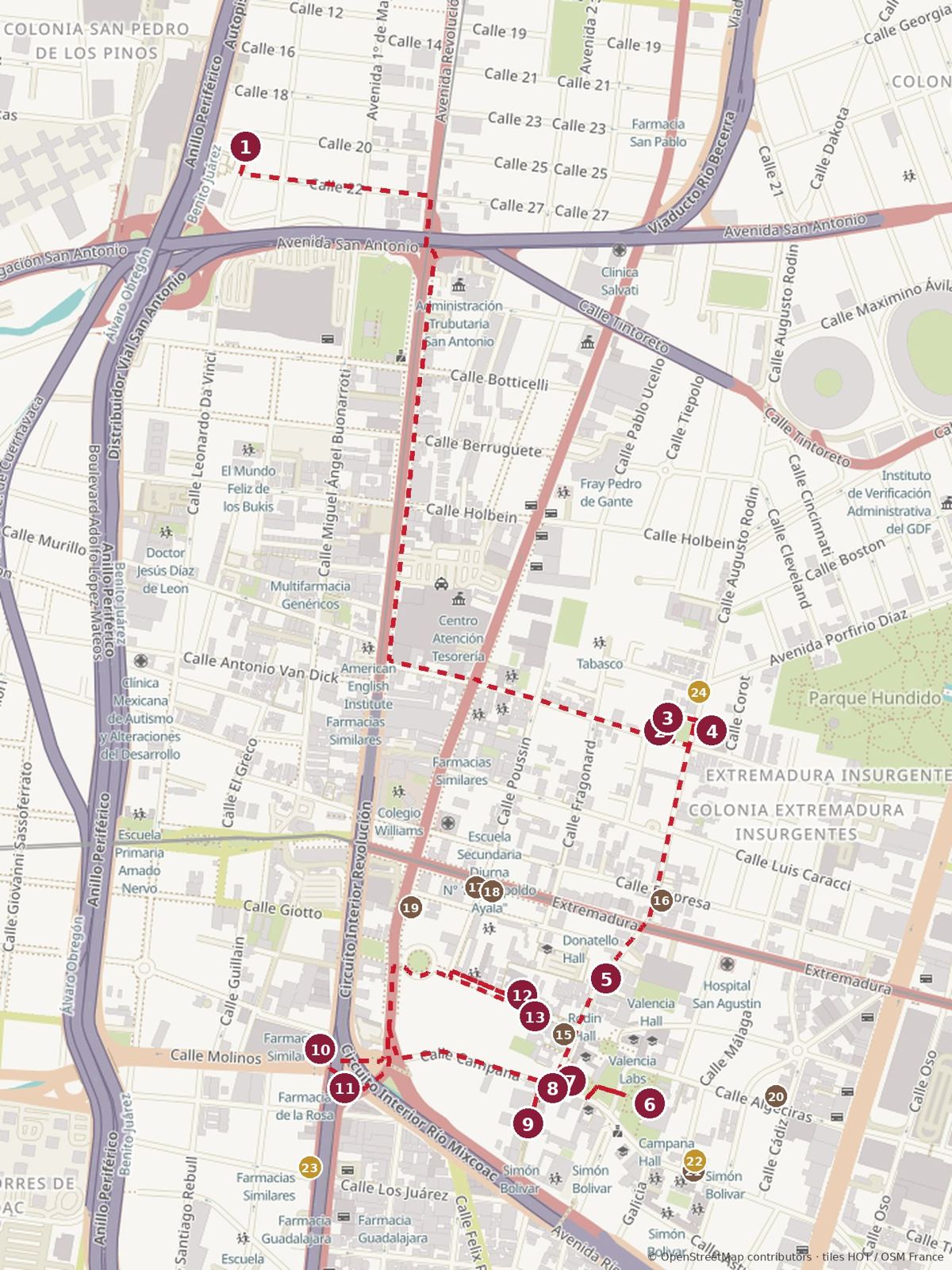
Coffee 14Casa Di Mahia · 15Cafetería Los Arcos · 16Onna · 17Relámpago Café · 18Morena Mía · 19Bunker Café · 20Hooco Café · 21Verdanna
Bakeries 22Zunilda Panadería · 23Pastelerías Esperanza · 24Aurelia Bakery
Click to enlarge. Map data © OpenStreetMap contributors.
| # | Stop | What it is |
|---|---|---|
| 1 | Zona Arqueológica de Mixcoac | Small Mexica pyramid site |
| 2 | Convento de Santa Catalina de Siena | Octavio Paz’s childhood house |
| 3 | Plaza Valentín Gómez Farías and Instituto Mora | Plaza and a president’s house |
| 4 | Parroquia de San Juan Evangelista | 17th-century stone church |
| 5 | Casa de Fernández de Lizardi and the old obraje | 1738 workshop, novelist’s house |
| 6 | Santo Domingo de Guzmán and the Muro de la Paz | Dominican church, 1595 |
| 7 | Plaza Jáuregui | The old town square |
| 8 | Centro Cultural Juan Rulfo | Old town hall, Eppens mural |
| 9 | Callejón del Diablo | The haunted alley |
| 10 | Mercado de Mixcoac | 1950s market |
| 11 | Fuente de Mixcoac | Serpent-head fountain |
| 12 | Biblioteca IBBY México | Children’s library |
| 13 | Centro Vlady | Painter Vlady’s archive |
The walk, part 1: the pyramid to San Juan
The first half starts with the oldest thing in Mixcoac and then crosses to the San Juan side, where the president, the poet’s grandfather and the nuns all lived around one plaza.
1. Zona Arqueológica de Mixcoac

Calle Pirámide 7, San Pedro de los Pinos · Tue–Sun 9:00–17:00 · free
Start at one of the smallest archaeological sites in the country: 7,200 square meters next to the Periférico, with a pyramid to Mixcóatl, two platforms, a central patio, a ceremonial plaza and the remains of adobe rooms. As boys, Octavio Paz and a cousin found what they thought was a pyramid here; nobody at home believed them. Get there at opening time, because the gate keeps irregular hours.
2. Convento de Santa Catalina de Siena
Plaza Gómez Farías 8 · exterior; food sales mostly on weekends, check · free
From the pyramid it is about 1.7 km (22 minutes) south-east to Plaza Gómez Farías; follow the map, or take a five-minute taxi if the traffic gets to you. The first building you want is the house of Ireneo Paz, where Octavio Paz spent his childhood. It is now a convent of Dominican nuns. They sell bread, cookies, preserves and tamales, mostly on weekends, and chiles en nogada in August and September. Go in the morning if you want to buy.
3. Plaza Valentín Gómez Farías and Instituto Mora

Plaza Valentín Gómez Farías 12 · plaza open; institute Mon–Fri about 8:00–20:00, check · free
Two minutes along the plaza is the house Gómez Farías bought, with orchards, wells and stables, and where he spent his last days. Since 1981 it has been the Instituto Mora, a public research institute named after his adviser, the liberal writer José María Luis Mora. You sign in at the entrance. Inside are a library, a Fondo de Cultura Económica bookshop and a small café, Opera 77, in the garden. Local legend says Gómez Farías rides his horse around the plaza at night, asking for forgiveness.
Bakery stop: Aurelia Bakery (Augusto Rodin 126; Mon–Fri 7:30–19:00, Sat–Sun 7:30–15:30), a minute up Augusto Rodin, is a tiny bakery that is easy to miss (gold circle on the map). Everything is made by hand. Get a concha, or one of the filled sweet breads, and eat it on a bench in the plaza. It sells out later in the day.
4. Parroquia de San Juan Evangelista

Augusto Rodin 330, on Plaza Gómez Farías · Tue–Fri 9:00–13:00 and 16:00–19:00, Sat 9:00–12:00, Sun 9:30–13:30, closed Mon · free
A minute across the plaza is the 17th-century church of the old village of San Juan, built of quarry stone inside and out. The facade has a carved Virgin of Guadalupe. Inside are a mostly neoclassical altarpiece and a wooden ceiling with saints in relief. It is often shut outside Mass times.
The walk, part 2: Plaza Jáuregui, the market and Goya
The second half crosses Extremadura to the Dominican church and the old town square, then heads west to the market for lunch and comes back to the library and the archive on Goya.
5. Casa de Fernández de Lizardi and the old obraje

Augusto Rodin 456 · exterior only · free
Walk about six minutes south on Augusto Rodin, crossing Extremadura at the lights. This long, low colonial building carries a plaque dated 1738. It is thought to have started as a small workshop making silk for New Spain’s elite, and Lizardi lived here later. Today it belongs to the Universidad Panamericana, whose campus fills the block, so you see it from the street. Look for the second plaque, for Octavio Paz.
6. Santo Domingo de Guzmán and the Muro de la Paz

Canova 2, at Augusto Rodin · Mon–Fri 8:00–14:00 and 15:00–20:00, Sat–Sun 9:00–14:00 · free
Five minutes on is the church that was the center of the old town of Mixcoac. Franciscans built it in 1595, the Dominicans took over in 1608, and the church and convent you see date from about 1648. Inside is the Capilla de la Virgen del Rayo. The parish offers occasional guided visits, in Spanish only. Facing the church across Augusto Rodin is the Muro de la Paz, a curved wall with life-size figures of the Dolorosa, Christ and St. John and a chapel to Our Lady of the Rosary. The old atrium and the plaza have nearly merged.
7. Plaza Jáuregui

Augusto Rodin s/n, at Goya · open space · free
Two minutes away is the old town square, formally the Plaza Agustín Jáuregui, with a bandstand, big trees, a bust of Jáuregui and a lot of squirrels. It is mostly a school zone, so expect students on weekdays and chess players on Wednesdays.
Coffee break: Cafetería Los Arcos (Goya 75, Local D; Mon–Fri 8:00–17:00, Sat 8:00–13:00), under the arches on Goya, is an old-fashioned place for a coffee (brown circle on the map).
8. Centro Cultural Juan Rulfo

Campana 59 · daily 8:00–20:00, check · free
Around the corner is the Porfirian town hall of the Municipality of Mixcoac, a cultural center since 1975. Step inside for Francisco Eppens’s 1979 mural Nuestras raíces culturales. The center runs concerts, theater and classes; check the program at the door. Two doors down, at Campana 47, the nuns of the Convento de la Visitación sell food and religious goods.
9. Callejón del Diablo
Off Campana · open street · free
A minute south is a narrow, tree-lined lane that a car barely fits down. In colonial times, the story goes, the devil waited here for anyone who crossed it at night, especially people who owed money. In the best-known version a skeptic saw a laughing shadow behind a tree, ran, and the ground opened under him. In daylight it is just a pretty lane. That is the version I recommend.
10. Mercado de Mixcoac
Av. Revolución s/n, at Tiziano · check hours · free
Walk about seven minutes west, crossing Patriotismo at the lights, to the market on Avenida Revolución. It opened in the 1950s as the Mercado José María Pino Suárez on the site of an older street market. Everyone calls it the Mercado de Mixcoac. Look up at the saw-tooth roof. Inside: piñatas, party sweets, flowers, seafood stalls and fondas with set lunches.
Lunch: Taquería Hermanos Luna (Giotto 2A; daily 8:30–23:30), about three minutes north of the market. It has been open since 1962 and still has a line out the door; it moves fast. Order a gordita (tripa, suadero, pastor or cheese, about 25 pesos, ~1.30 USD, in 2022) and a cold tepache. You share a table with strangers. The alternative is Gorditas Mixcoac, a family stall of more than 40 years at the market (Tiziano 3; daily 7:30–20:00), with chicharrón prensado, requesón and chicken tinga, from 15 pesos (~0.80 USD) in 2022.
11. Fuente de Mixcoac
Av. Revolución at Av. Río Mixcoac · open space · free
A minute away, in the middle of the traffic, is a cantera stone fountain from 2000 with serpent heads: the cloud serpent again, done large. See it from the corner; don’t try to cross to it.
12. Biblioteca IBBY México

Goya 54 · daily 10:00–16:45 · free to read
Walk about seven minutes back east to Goya, crossing Patriotismo at the lights. IBBY México’s library for children and teenagers fills an old house with gardens; anyone can sit and read, and it doubles as a bookshop.
Coffee break: Casa Di Mahia, to the left of the library entrance, is a good café and the best toilet stop on this half of the walk (brown circle on the map).
13. Centro Vlady

Goya 63 · Mon–Fri 10:00–18:30, Sat–Sun 10:00–18:00, check
Across Goya is the archive of the painter Vladimir Kibalchich, Vlady, who arrived in Mexico as a refugee in 1943 with his father, the writer Victor Serge. He donated some 4,600 works; about a thousand form the collection, which the city university, UACM, looks after. There is usually an exhibition on. Metro Mixcoac is about five minutes away, or call an Uber from Goya.
A drink to finish: La Flor de Valencia (Av. Revolución 1011; Mon–Wed and Sat 10:00–22:30, Thu–Fri 10:00–23:30, closed Sun) is a classic cantina about ten minutes south-west, two blocks south of the market. Time Out called it gloomy in 2012, and meant it kindly: dark wood, old waiters, good food. It works best with a group.
Coffee, food and drink
For coffee, go to Casa Di Mahia or Aurelia; for lunch, Hermanos Luna or the market; for the evening, La Flor de Valencia.
| Place | What | Where |
|---|---|---|
| Aurelia Bakery | Artisan bread, conchas | Augusto Rodin 126, near stop 3 |
| Opera 77 | Café in the Instituto Mora garden | Stop 3 |
| Cafetería Los Arcos | Old-style café under the arches | Goya 75, on Plaza Jáuregui, stop 7 |
| Casa Di Mahia | Café at the IBBY library | Goya 54, stop 12 |
| Onna | Café | Augusto Rodin 410, between stops 4 and 5 |
| Relámpago Café | Coffee bar | Poussin 24, near stop 13 |
| Bunker Café | Specialty coffee | Av. Patriotismo 851, near stop 12 |
| Zunilda Panadería | Bakery | Málaga 94, near stop 6 |
| Taquería Hermanos Luna | Gorditas, pastor, tepache | Giotto 2A, near stop 10 |
| Gorditas Mixcoac | Gorditas, huaraches | Tiziano 3, stop 10 |
| Tortas El Capricho | Tortas of stewed meat; open Sundays | Augusto Rodin 407, near stop 5 |
| La Flor de Valencia | Cantina | Av. Revolución 1011, south of stop 11 |
If you just want a familiar cup, the chains sit at the edges of the route:
- Starbucks at Av. Revolución 780, north of the market
- Starbucks at Insurgentes Sur 1405 and in the Manacar tower at Insurgentes Sur 1457, east of Santo Domingo
- Cielito Querido at Insurgentes Sur 1602, further south
Shops worth the detour
Mixcoac’s shopping is books and things made by nuns.
- Instituto Mora (stop 3): a Fondo de Cultura Económica bookshop with the institute’s own history titles.
- IBBY México (stop 12): children’s and young adult books in Spanish, sold as well as lent.
- Convento de Santa Catalina de Siena (stop 2): the nuns’ bread, cookies, preserves and seasonal chiles en nogada.
- Convento de la Visitación (Campana 47, near stop 8): food and religious goods sold by the sisters.
- Mercado de Mixcoac (stop 10): piñatas, party sweets and flowers.
Which day to walk
Saturday gets you the most; Monday the least. Only the stops with limited days are listed below.
| Stop | Mon | Tue–Fri | Sat | Sun |
|---|---|---|---|---|
| 1 Zona Arqueológica | Closed | Open | Open | Open |
| 2 Santa Catalina (food sales) | No | Some days | Yes | Yes |
| 3 Instituto Mora (inside) | Open | Open | Closed | Closed |
| 4 San Juan Evangelista | Closed | Open | Until 12:00 | Until 13:30 |
| 6 Santo Domingo | Open | Open | Until 14:00 | Until 14:00 |
On a Sunday, Cafetería Los Arcos and La Flor de Valencia are closed and Aurelia shuts at 15:30; Hermanos Luna is open every day until 23:30.
Keep walking
East: Parque Hundido and Insurgentes. From Plaza Gómez Farías, walk about ten minutes east to Parque Hundido (Parque Luis G. Urbina) and its big floral clock. Metrobús Line 1 runs along Insurgentes beside it.
North: Tacubaya. Avenida Revolución runs north from the market to Tacubaya. San Miguel Tacubaya on Foot covers it.
South: San Ángel. Revolución continues south to San Ángel, a short taxi or a long walk from the cantina.
About the author and where to stay
Brian has lived in Roma Norte for about five years and writes the See Mexico City guides. He speaks seven languages and still gets lost on purpose.
When you visit, stay with us at Penthouse El Cielo de Roma in Roma Norte.
Photo credits
Photos via Wikimedia Commons, used under the licenses shown. Numbers match the captions.
- Main pyramid – Archeological Zone of Mixcoac – Mexico 2024 (4).jpg, José Luiz, CC BY-SA 4.0
- Instituto Mora, from across the Valentín Gómez Farías square (1).jpg, Gunnar Wolf, CC BY-SA 3.0
- Parish of San Juan Evangelista and Our Lady of Guadalupe, from across the Valentín Gómez Farías square.jpg, Gunnar Wolf, CC BY-SA 3.0
- House of José Joaquín Fernandez de Lizardi – Plaza Agustín Jáuregi – Mixcoac – Mexico 2024.jpg, José Luiz, CC BY-SA 4.0
- Interior de capilla en Parroquia de Santo Domingo de Guzman 2023.jpg, Claudia sangines sayavedra, CC BY-SA 4.0
- Plaza Agustín Jáuregi – Mixcoac – Mexico 2024.jpg, José Luiz, CC BY-SA 4.0
- 'Nuestras Raíces Culturales' (1979) by Francisco Eppens – Centro Cultural Juan Rulfo – Mixcoac – Mexico 2024.jpg, José Luiz, CC BY-SA 4.0
- La Casa de la Araucaria – Calle Goya 54 – Mixcoac – Mexico 2024.jpg, José Luiz, CC BY-SA 4.0
- Casa Vlady.jpg, Gunnar Wolf, CC BY-SA 3.0
Map: drawn from OpenStreetMap data, © OpenStreetMap contributors, Open Database License.
Sources
Hours and prices checked October 2026; confirm before you go.
- Wikipedia: Mixcoac
- Mexico City tourism: Parish Church Santo Domingo de Guzmán, San Juan Malinaltongo, Casa de Joaquín Fernández de Lizardi, Centro Vlady, Mercado de Mixcoac
- Archivo CDMX: Mixcoac, barrio mágico
- Atlas Obscura: Plaza Valentín Gómez Farías
- Time Out México: Instituto Mora, La Flor de Valencia
- Chilango: Mixcoac, el barrio mágico de la ciudad, Recorrido de leyendas en Mixcoac, Barrios mágicos en el DF
- México Desconocido: Mixcoac, un referente en la infancia de Octavio Paz
- Gaceta UNAM: Abre al público la Zona Arqueológica de Mixcoac
- Excélsior: Qué significa Mixcoac, Paseos históricos gratis, junio 2026
- El Financiero: Mixcoac, el barrio de las legendarias gorditas
- Local.mx: Guía local: barrio de Mixcoac
- INBA: Mixcoac, lugar emblemático en la literatura mexicana
- N+: Lista completa de los Barrios Mágicos de la CDMX