Inner Northwest: Santa Julia on Foot
Why Santa Julia
Santa Julia is the barrio that gave Mexico a saying. “Lo agarraron como al Tigre de Santa Julia”, they caught him like the Tiger of Santa Julia, means caught with your pants down, and the Tiger was a real bandit from these streets. The barrio also has two neo-Gothic churches, a market known for carnitas and chicharrón prensado, a 1940s cinema turned into a cultural center, and an Orozco mural most people in the city have never seen.
It sits in the borough of Miguel Hidalgo, just west of the Circuito Interior (Melchor Ocampo) and south of the Calzada México-Tacuba, across from Santa María la Ribera and just north of Polanco. The old barrio is now split between Colonia Tlaxpana, around the market, and Colonia Anáhuac, around the Salesian church and park. The old name survives in the market, a coffee roaster and the saying.
This walk is for people who want a working barrio with no tourists at all. It is not a pretty neighborhood. It is workshops, warehouses, schools, tire shops and one-story houses, with the occasional 1910 mansion. Anáhuac also has a crime problem (see below). Walk it in daylight, on a weekday, and you will be fine and very well fed.
Practical basics
The walk is about 3 km, one way, and takes a morning with stops. Take an Uber or taxi to the start and home from the end. Do it Tuesday to Friday, starting around 10:00.
| Start | Benemérita Escuela Nacional de Maestros, Calzada México-Tacuba 75 |
| Finish | Casonas of Laguna del Carmen, at Lago de Chalco, by the Parque Salesiano; Bago Café is a few steps away |
| Distance | About 3 km; roughly 40 minutes of pure walking |
| Time needed | 3 hours with the market, lunch and coffee |
| Best day | Tuesday to Friday: the teachers’ college, the FARO and Bago Café are all open |
| Avoid | Sundays and Mondays, and any time after dark |
| Toilets | FARO Cosmos has public restrooms; Bago Café at the end |
If you come by public transport, Metro Normal (Line 2) is right at the start, between the teachers’ college and the FARO. From the finish, Metro Colegio Militar (Line 2) is about eight minutes’ walk northeast on the Calzada México-Tacuba.
On a Saturday the teachers’ college is closed; start at the FARO instead (it opens at 10:00) and the walk is the same minus 300 meters. If you are short of time, skip Laguna de Términos (stop 5) and walk from the market straight up to the church.
Now the honest part. In 2019 Anáhuac’s two sections had nearly half of all the reported crime in the borough of Miguel Hidalgo, mostly violent robbery of pedestrians, cars and shops. Residents named Lago Hielmar, Lago Nahuel, the Laguna de Mayrán area and the passage toward Polanco as the bad spots; this route uses none of them. In daylight the streets on this route are full of people working and shopping. Don’t walk it after dark, don’t wave a phone or camera around on empty blocks, carry small cash for the market, and take a ride from the end rather than wandering west.
A short history
After the Conquest, Hernán Cortés took the lands of Tlaxpana, a name Chilango translates as “the place where they sweep”, and planted an orchard. In the second half of the 17th century Captain Pedro Ruiz de Castañeda founded the Hacienda de la Ascensión de Cristo Nuestro Señor here, growing wheat, corn, beans and vegetables for the city.
Its last owner was Julia Gómez de Escalante. In 1894 she and Eduardo Zozaya divided the hacienda into blocks of 200 by 140 meters with 15-meter streets, and in 1902 the colonia Santa Julia was founded. One old resident told México Desconocido that doña Julia was so kind that everyone called her a saint. The streets near the market got the names of Mexica rulers and gods, Atzayácatl, Tláloc, Tonantzin, Nezahualpilli. Further west, in what became Anáhuac, they are lakes and lagoons, Laguna de Guzmán, Laguna de Términos, Lago de Chalco.
The Salesians came first. They founded their school here in 1889, on donated land, and laid the cornerstone of their church in 1897. Revolution and the Cristero war stopped it for decades; work only restarted in 1954. Around 1900 the barrio got its outlaw. José de Jesús Negrete, born in Guanajuato in 1873, an army deserter, lived in Santa Julia and robbed with a gang from here. He got the nickname “El Tigre” after killing two guards in an escape. Police caught him on 30 May 1906 in Tacubaya, reportedly while he was relieving himself behind a house, and he was shot by firing squad at Belén prison on 22 December 1910. Some say he gave to the poor. The papers loved him either way.
In the 20th century Santa Julia filled with workshops, warehouses, small factories and schools. Mario Pani built the new national teachers’ college on México-Tacuba from 1945, with murals by José Clemente Orozco. The Cine Cosmos opened in 1946, burned months later and reopened in 1948. On 10 June 1971, the day of the Halconazo, when government-trained thugs attacked a student march on this avenue, students ran into the Cosmos to hide.
In 2011 the city named Santa Julia one of its 21 Barrios Mágicos. The designation covered the old barrio of Tlaxpana and Anáhuac and pointed visitors to the two churches, the Parque Salesiano, the old houses and the market; the formal declaration was never completed. Ten years later, in March 2021, the city reopened the Cosmos, empty for decades, as the FARO Cosmos arts center.
The route
The walk runs one way, from the teachers’ college on México-Tacuba south into Tlaxpana for the market, then west and north through Anáhuac to the Salesian church, the park and the old houses beside it, in 8 numbered stops. Follow it on the Santa Julia on Foot map, which shows every stop, the walking route, and the coffee places and bakeries near it.
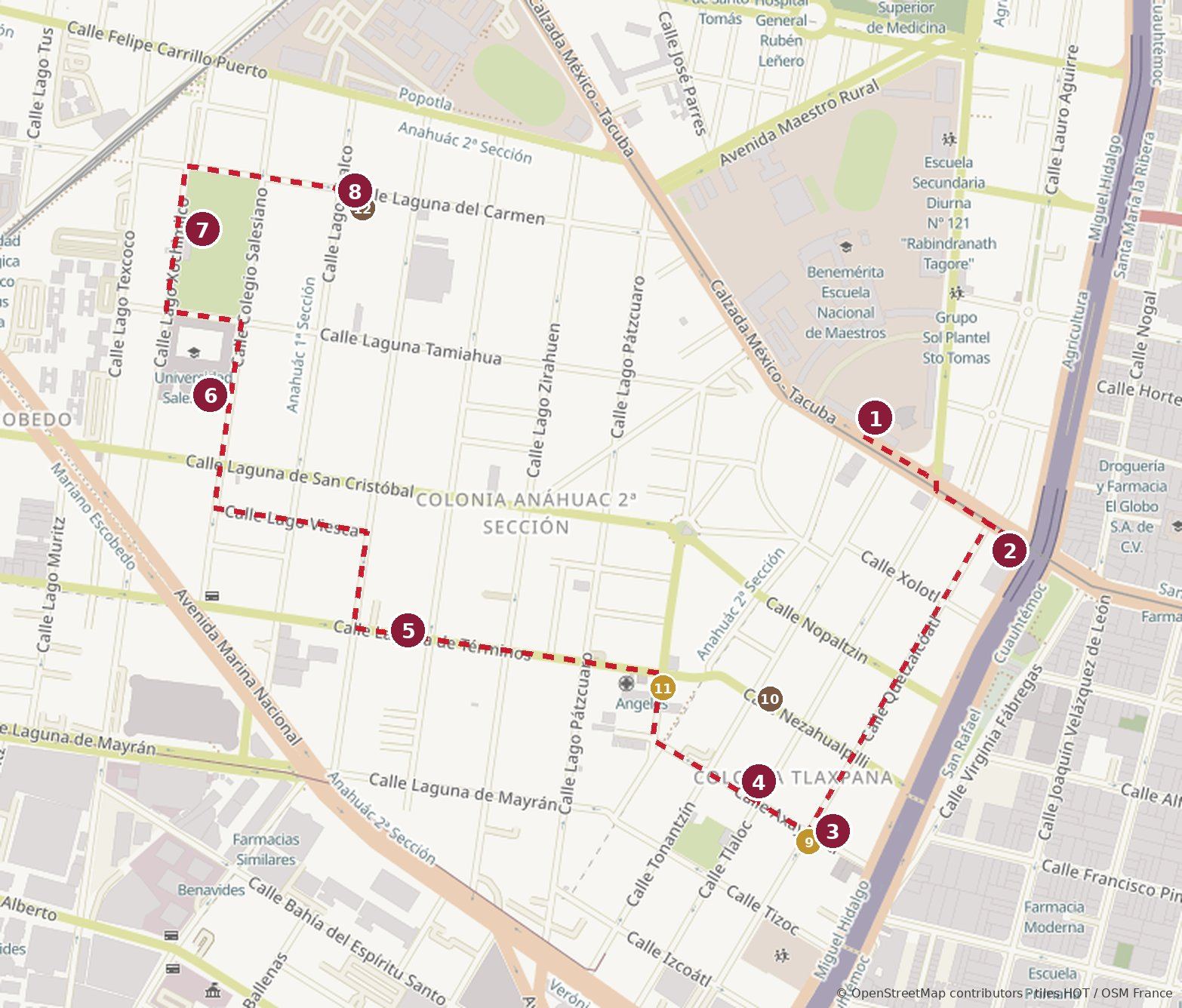
Coffee 10Tostadores de Café Santa Julia · 12Bago Café
Bakeries 9El Mejor Pan · 11Panadería La Estrella
Click to enlarge. Map data © OpenStreetMap contributors.
| # | Stop | What it is |
|---|---|---|
| 1 | Benemérita Escuela Nacional de Maestros | Pani building, Orozco mural |
| 2 | FARO Cosmos | 1940s cinema, now arts center |
| 3 | Capilla del Divino Rostro | Neo-Gothic chapel |
| 4 | Mercado Anáhuac (Mercado de Santa Julia) | The barrio market |
| 5 | Laguna de Términos | Shopping street of workshops |
| 6 | Santuario de María Auxiliadora | Salesian neo-Gothic church |
| 7 | Parque Salesiano | The barrio park |
| 8 | Casonas of Laguna del Carmen | Houses from about 1910 |
The walk, part 1: México-Tacuba to the market
The first half covers the big buildings on the avenue, then drops into the old streets of Tlaxpana for the chapel and the market.
1. Benemérita Escuela Nacional de Maestros

Calzada México-Tacuba 75 · Mon–Fri 7:30–18:00 · free
Start at Mexico’s national teachers’ college, a working school. Mario Pani designed the complex from 1945. Its ten-story tower, which you can still see in the logo of Metro Normal, began to lean after the 1957 earthquake and was taken down in 1972. What remains is very good. Luis Ortiz Monasterio carved the 60-meter frieze on the main facade, and in the curved open-air theater is Orozco’s Alegoría Nacional, about 400 square meters of it. Time Out’s advice, which still works, is to ask the guard politely to let you in for a look. Strictly speaking, the school is across México-Tacuba in Colonia Un Hogar para Nosotros.
2. FARO Cosmos

Calzada México-Tacuba at Circuito Interior · Mon–Sat 10:00–19:00, closed Sun · free
Cross México-Tacuba at the lights and walk four minutes southeast to the corner with the Circuito Interior. The Cine Cosmos was one of the big golden-age picture palaces. It opened in 1946, burned, and reopened in 1948. On 10 June 1971 students fleeing the Halconazo hid inside. Then it sat empty for decades. TEN Arquitectos, Enrique Norten’s firm, rebuilt it, and Claudia Sheinbaum reopened it in 2021 as a FARO, one of the city’s Fábricas de Artes y Oficios, public arts and trade schools. Inside are a cinema, a black-box theater, galleries, a roof terrace and a monument to the 1971 student movement. Ask what is on.
3. Capilla del Divino Rostro
Atzayácatl 80 · Mon–Fri 10:00–13:00 and 18:00–21:00, Sat 9:00–12:00 and 18:00–21:00 · check hours · free
Walk about eight minutes south, keeping to the west side of the Circuito, to Atzayácatl. Half a block from the Circuito is the barrio’s smaller church. It is neo-Gothic, with pointed arches and stained glass, and the inside has recently been restored. Chilango’s Barrios Mágicos route names it together with María Auxiliadora. It is often shut outside Mass times, so take what you can get.
Bakery: El Mejor Pan (Atzayácatl 74) is a few doors along. Gold circle on the map.
4. Mercado Anáhuac (Mercado de Santa Julia)
Atzayácatl at Tláloc and Tonantzin · daily 8:00–19:00 · free
Walk two minutes west. The market is officially the Mercado Anáhuac; everyone calls it Santa Julia. It has a clothes section and a food section, and the food section is the point. The annex across Tonantzin (daily 7:00–19:00) sells tools, clothes and everything else, and has jewelry and watch repair stalls.
Lunch: the market fondas. The barrio is known for carnitas and chicharrón prensado, the pressed pork scraps that go into gorditas and tacos; Time Out singles out the chicharrón prensado, and one reviewer ate well for 45 pesos (~2.40 USD). Or go back two minutes to Canto de Sirenas (Atzayácatl 89, daily 9:00–21:00), across from the chapel, for seafood.
Coffee break: Tostadores de Café Santa Julia (Nezahualpilli 26-B, on the corner of Tonantzin, Mon–Sat 11:00–16:00), two blocks north, roasts beans and pours a good cup. Brown circle on the map.
The walk, part 2: Laguna de Términos to the Parque Salesiano
The second half crosses into Anáhuac, past the workshops, to the Salesian church, the park and the old houses beside it.
5. Laguna de Términos
Laguna de Términos at Lago Cuitzeo · shop hours vary · free
Walk about nine minutes northwest. On the way you cross Laguna de Guzmán, where México Desconocido describes a small tianguis of tools, books and used goods. Laguna de Términos is the barrio’s practical shopping street: charcoal sellers, glass shops, workshops, grocers and a fruit and vegetable market, as México Desconocido lists them, and a truck with a loudspeaker going round buying used goods. At number 448, Tortillería Anáhuac sells corn tortillas for 18 pesos (~1 USD) a kilo, which is as good a souvenir as any.
Bakery on the way: Panadería La Estrella (Laguna de Guzmán 104, daily 6:30–22:15), a neighborhood bakery, open from early morning to late at night. Gold circle on the map. Down the street at number 96, Carnitas estilo Michoacán “Santa Julia” sells carnitas by the kilo.
6. Santuario de María Auxiliadora
Colegio Salesiano 61 · check hours · free
Walk about eight minutes northwest to the street called Colegio Salesiano. This is the church the barrio is proud of, neo-Gothic, built over most of a century. The Salesians founded their school here in 1889 and laid the cornerstone in 1897. Work stopped in 1899, restarted in 1906 with an iron frame, and stalled at about six meters during the Revolution. After the Cristero war the government took the property; the Salesians only got it back in 1950 and restarted work in 1954. Vicente Mendiola, who also built the Parroquia Votiva on Reforma, worked from Adrián Giombini Montanari’s 1905–06 designs. The 3.6-meter Virgin over the altar and the angels on the steps, added in 1992, are by Ernesto Tamariz. San Juan Bosco stands over the door, there are six side chapels and a marble baldachin over the high altar. The feast is on 24 May.
7. Parque Salesiano
Between Lago de Chalco and Laguna de Tamiahua · open 24 hours · free
The park is a block north. It is the barrio’s living room: shady trees, playgrounds, a basketball court, a dog run, benches and a sculpture of Felipe Carrillo Puerto, the socialist governor of Yucatán, by Humberto Peraza. It is busy and pleasant by day. Locals say it is not a place to hang around at night.
8. Casonas of Laguna del Carmen
Laguna del Carmen at Lago de Chalco · exterior only · free
On the east side of the park, where Laguna del Carmen meets Lago de Chalco, are some of the houses built around 1910, when Santa Julia was a new suburb. They are what the barrio looked like before the workshops and the warehouses. People live in them, so look from the sidewalk.
Coffee to finish: Bago Café (Laguna del Carmen 93, Tue–Sun 8:30–22:30, closed Mon), a few steps away, with a roof terrace. Brown circle on the map. Call your ride from here.
Coffee, food and drink
For coffee, go to Bago Café or the Santa Julia roasters; for lunch, the market or Canto de Sirenas.
| Place | What | Where |
|---|---|---|
| Bago Café | Coffee, breakfast, roof terrace | Laguna del Carmen 93, by stop 8 |
| Tostadores de Café Santa Julia | Roaster, coffee, beans | Nezahualpilli 26-B at Tonantzin, near stop 4 |
| Panadería La Estrella | Pan dulce | Laguna de Guzmán 104, between stops 4 and 5 |
| El Mejor Pan | Bakery | Atzayácatl 74, by stop 3 |
| Canto de Sirenas | Seafood, ceviche | Atzayácatl 89, by stop 3 |
| Mercado Anáhuac fondas | Carnitas, chicharrón prensado, comida corrida | Stop 4 |
| Carnitas estilo Michoacán “Santa Julia” | Carnitas by the kilo | Laguna de Guzmán 96, between stops 4 and 5 |
| Tortillería Anáhuac | Corn and flour tortillas | Laguna de Términos 448, stop 5 |
| Garda Comedor | Mexican lunch, molcajetes | Lago Garda 110, five minutes west of stop 7 |
| La Bodega de los Malazzo | Argentine grill | Lago Iseo 298, a detour southwest |
Canto de Sirenas has been serving the barrio for decades. It is big, fast and always busy. A seafood cocktail at 11:00 is perfectly normal here. The combination ceviche and the shrimp empanadas are what everyone orders.
Panadería La Estrella is the kind of bakery reviewers mostly talk about for the prices.
Bago is a pet-friendly café with good espresso drinks, a chai latte people like, pastries and breakfast, and a roof terrace. It is pricier than the rest of the barrio, and the most comfortable place on the walk to sit for a while.
If you just want a familiar cup, there is no chain café on the route. The nearest Starbucks is in the BBVA tower area at Lago Alberto 320, about a kilometer west of stop 5, and it is open on weekdays only.
Shops worth the detour
Santa Julia does not sell anything to tourists. That is the attraction.
- Mercado Anáhuac annex (stop 4): tools, clothes, and stalls that repair jewelry and watches while you wait.
- Tostadores de Café Santa Julia (near stop 4): freshly roasted beans to take home.
- Laguna de Guzmán tianguis (between stops 4 and 5): tools, secondhand books and used goods.
- Laguna de Términos (stop 5): charcoal, glass and hardware, for the full barrio experience.
- Panadería La Estrella (between stops 4 and 5): a bag of pan dulce for the ride home.
Which day to walk
Tuesday to Friday gets you everything; Sunday and Monday the least. Only the stops with limited days are listed below.
| Stop | Mon | Tue–Fri | Sat | Sun |
|---|---|---|---|---|
| 1 Escuela Nacional de Maestros | Open | Open | Closed | Closed |
| 2 FARO Cosmos | Open | Open | Open | Closed |
| 3 Divino Rostro | Mornings and evenings | Mornings and evenings | Mornings and evenings | Closed |
Bago Café, at the end, is closed on Monday, and the roasters on Sunday. On a Saturday, start at the FARO. On a Monday, have your coffee at the Santa Julia roasters instead of Bago.
Keep walking
Santa Julia borders other walks in this series.
- East: Santa María la Ribera. From the FARO (stop 2), cross the Circuito Interior on México-Tacuba and keep east; within about fifteen minutes you are in Santa María la Ribera, with the Kiosco Morisco and the Museo del Chopo. Santa María la Ribera on Foot covers it.
- Southeast: San Rafael and San Cosme. México-Tacuba becomes Ribera de San Cosme east of the Circuito. Follow it about 15 minutes to the Casa de los Mascarones, stop 13 of San Rafael on Foot.
- Northwest: Popotla and Tacuba. From the finish, Metro Colegio Militar is one stop from Popotla and two from Tacuba, another of the city’s Barrios Mágicos and the start of Chilango’s Barrios Mágicos route through this part of town.
About the author and where to stay
Brian has lived in Roma Norte for about five years and writes the See Mexico City guides. He speaks seven languages and still gets lost on purpose.
When you visit, stay with us at Penthouse El Cielo de Roma in Roma Norte.
Photo credits
Photos via Wikimedia Commons, used under the licenses shown. Numbers match the captions.
- Vista aérea de la Benemérita Escuela Nacional de Maestros 01.jpg, ProtoplasmaKid, CC BY-SA 4.0
- Vista aérea del Cine Cosmos 01.jpg, ProtoplasmaKid, CC BY-SA 4.0
Map: drawn from OpenStreetMap data, © OpenStreetMap contributors, Open Database License.
Sources
Hours and prices checked October 2026; confirm before you go.
- México Desconocido: Santa Julia
- México Desconocido: El Tigre de Santa Julia, el ladrón que robaba a los ricos
- México Desconocido: La Escuela Normal de Maestros, una obra de Mario Pani y de José Clemente Orozco
- Time Out México: Barrio de Santa Julia
- Time Out México: Benemérita Escuela Nacional de Maestros
- Chilango: De Santa Julia a Mixquic, ruta de Barrios Mágicos en CDMX
- Chilango: Barrios mágicos en el DF
- Chilango: Mapa de Barrios Mágicos en la CDMX
- Chilango: Héroes chilangos, El Tigre de Santa Julia
- Mexico City tourism: FARO Cosmos
- Mexico City tourism: Santuario de María Auxiliadora
- La Razón: FARO Cosmos recupera memoria histórica (March 2021)
- Local.mx: Mario Pani and the Escuela Normal de Maestros
- Grupo Animal: Anáhuac, la colonia con la mitad de los delitos de la alcaldía Miguel Hidalgo (July 2019)