North: La Villa on Foot
Why La Villa
La Villa is where Mexico goes to church. The Basílica de Guadalupe gets more visitors than any Catholic shrine except the Vatican, and the hill behind it is covered in chapels, gardens and souvenir stalls. Most visitors see the image, buy a rosary and leave. This walk does a bit more.
It sits in the north of the city, in the borough of Gustavo A. Madero, about 6 km north of the Zócalo. The old town of Guadalupe Hidalgo grew at the foot of the Cerro del Tepeyac, reached from the south by the Calzada de los Misterios, the old pilgrims’ road, still lined with 17th-century rosary monuments. The walk follows it north, climbs the hill and finishes in a lunch market.
This walk suits people curious about Mexican Catholicism without necessarily sharing it, and architecture fans: five centuries of churches stand within a few hundred meters. It is not pretty everywhere. The Calzada is a wide, noisy road, the monuments are scratched and parked against, and the streets around the basilica are one long souvenir stall. That is part of the point.
Practical basics
The walk is about 4 km, one way, and takes half a day with stops. Take an Uber or taxi to the start and home from the end. Go on a Tuesday, Wednesday or Thursday, when everything is open and the crowds are bearable.
| Start | Misterio Glorioso 1, Calzada de los Misterios at Av. Necaxa, Col. Industrial |
| Finish | Mercado Villa Comidas, 5 de Febrero at Gral. Pedro María Anaya, east of the basilica |
| Distance | About 4 km; roughly 55 minutes of pure walking, with stairs up and down the Tepeyac |
| Time needed | 4–5 hours with the two museums, the hill and lunch |
| Best day | Tuesday to Thursday: both museums, the wax museum and the weekday-only churches are open |
| Avoid | Mondays, when both museums are shut, and the days from about 9 to 12 December |
| Toilets | Pay toilets in the basilica complex (bring coins); aiko café and the markets |
For public transport, the Metrobús Line 7 Excélsior stop, on the Calzada de los Misterios, is about six minutes’ walk south of the start. At the end, Metro La Villa-Basílica (Line 6) is about nine minutes south-west of the market.
Around 12 December, the Virgin’s feast, millions of pilgrims arrive, many on foot, and the area closes to traffic. It is extraordinary, but it is not a walking tour. Weekends are busy all year. If you are short of time, start at Misterio Glorioso 4 (stop 4) and skip the railway museum. That cuts about 1.2 km.
The basilica area is heavily policed and feels safe in daylight; scams are the problem. People outside the Metro offer blessings or fortunes and then ask to bless your wallet; one family lost 400 pesos (~21 USD) each this way. Say no and keep walking. Keep your phone in a front pocket in the crowds, and do not continue south on the Calzada de los Misterios past the start, towards Peralvillo.
A short history
Before the Spanish, the Tepeyac hill had a shrine to the goddess Tonantzin. In December 1531, according to the Guadalupan tradition, the Virgin appeared here to Juan Diego, an Indigenous convert, and left her image on his cloak. The town was founded in 1563, royal decrees of 1733 and 1748 made it a villa with its own government, and on 12 February 1828 it became the city of Guadalupe Hidalgo, after the hero of Independence.
Pilgrims needed a road. In 1675 Francisco Marmolejo and Isidro Zuriñana planned 15 monuments along the causeway from the city, one for each mystery of the rosary, and they were finished in 1676. Each was about 8 meters high. The causeway became a proper avenue in 1854. When the railway came through in the 19th century, seven of the 15 monuments were wrecked; they were rebuilt between 1997 and 1999. Eight are original.
The town had its moment in world history on 2 February 1848, when Mexico and the United States signed the Treaty of Guadalupe Hidalgo in the basilica’s sacristy, ending the war and handing about half of Mexico’s territory to its neighbor. In 1931 the town was absorbed into Mexico City, and its borough now carries the name of Gustavo A. Madero, brother of President Francisco I. Madero.
Churches kept going up, from the Capilla de Indios of 1649 to the old basilica of 1695–1709 and the Pocito of 1777–1791. On 14 November 1921 a bomb hidden in a flower arrangement exploded at the old basilica’s main altar. The image survived.
The old basilica was sinking into the lakebed, so a new one was built in 1974–1976, and the image moved there on 12 October 1976. In 2011 the city government began its list of Barrios Mágicos, neighborhoods it promotes for their history and traditions; the Villa de Guadalupe is one of them.
The route
The walk runs one way, north up the Calzada de los Misterios, over the Tepeyac and east to the markets, in 15 numbered stops. Follow it on the La Villa on Foot map, which shows every stop, the walking route and the nearest coffee and bakeries.
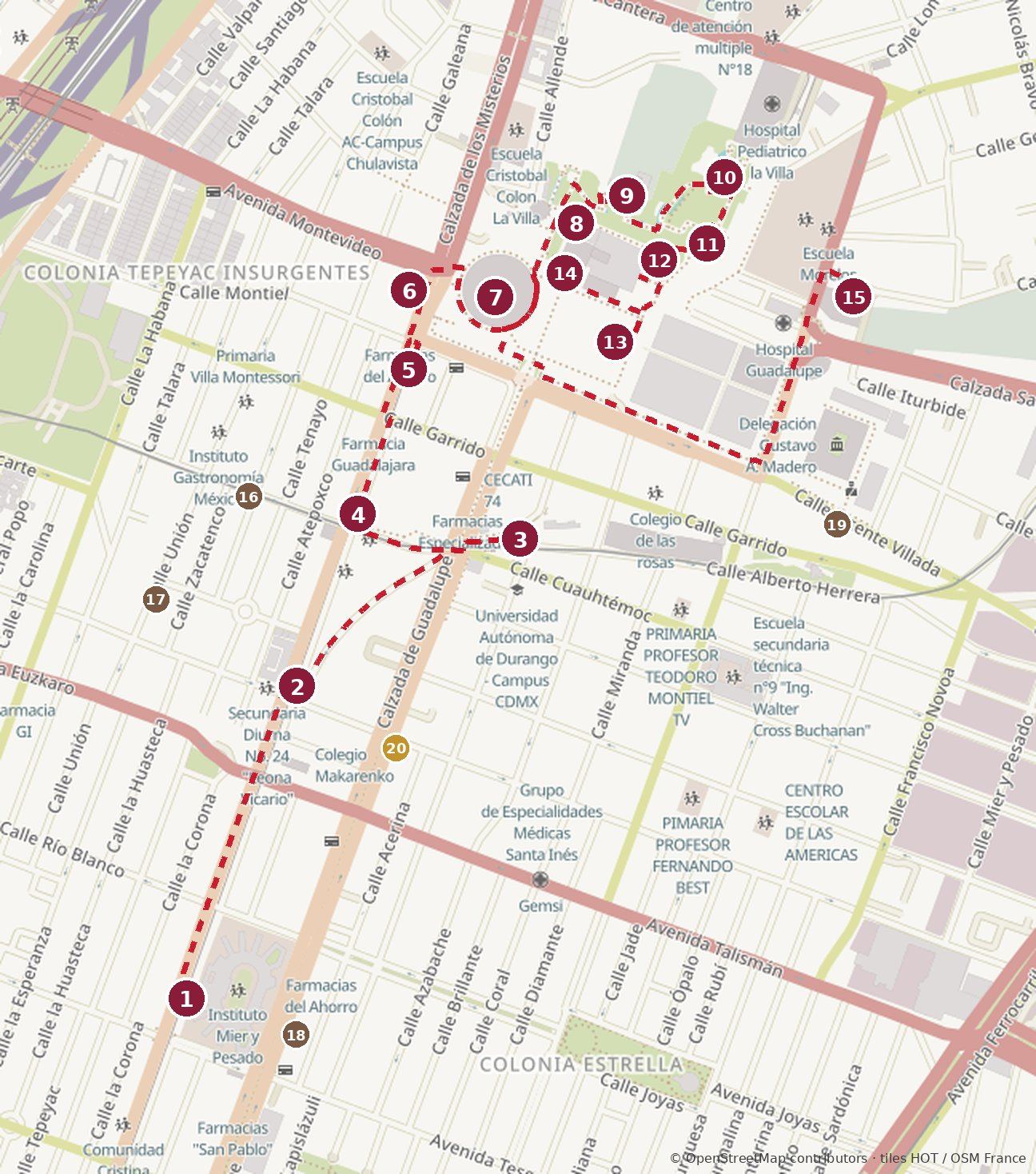
Coffee 16aiko café · 17Fortuna Café de Especialidad · 18Cafetería Cafetzin · 19Squisito Café
Bakeries 20Pastelería y Panadería Lecaroz
Click to enlarge. Map data © OpenStreetMap contributors.
| # | Stop | What it is |
|---|---|---|
| 1 | Misterio Glorioso 1 | Rebuilt rosary monument |
| 2 | Misterios Gloriosos 2 and 3 | Two more rosary monuments |
| 3 | Museo de los Ferrocarrileros | Railway museum in the 1907 station |
| 4 | Misterio Glorioso 4 | Rosary monument |
| 5 | Misterio Glorioso 5 | Original 17th-century monument |
| 6 | Museo de Cera de la Villa | Wax museum, since 1957 |
| 7 | Basílica de Guadalupe | The 1976 basilica |
| 8 | Museo de la Basílica | Guadalupe art museum |
| 9 | Capilla del Cerrito | Hilltop chapel and lookout |
| 10 | Jardín del Tepeyac and La Ofrenda | Garden and bronze fountain |
| 11 | Capilla del Pocito | Round baroque chapel |
| 12 | Parroquia de Indios and Capilla de Juramentos | Oldest church and the oath chapel |
| 13 | Carillón and Plaza Mariana | Bell tower and 2011 plaza |
| 14 | Antigua Basílica and Capuchinas | The 1709 basilica and the nuns’ church |
| 15 | Mercado Villa Comidas and Mercado Villa Zona 34 | Lunch market and gorditas |
The walk, part 1: the Calzada de los Misterios
The first half follows the pilgrims’ road north, with a detour to the old railway station, and ends at the gates of the basilica with a wax museum.
Before you start: Cafetería Cafetzin (Calzada de Guadalupe 537), a couple of minutes from the first monument, does espresso and chilaquiles (brown circle on the map).
1. Misterio Glorioso 1
Calzada de los Misterios at Av. Necaxa, Col. Industrial · street monument · free
Start at the eleventh of the 15 monuments, the first of the five Glorious Mysteries: the Resurrection. It is one of the seven rebuilt in 1999, so it is in better shape than most. Metrobús Line 7’s double-deckers run down the middle of the Calzada. Walk north on the east side, where the monuments stand.
2. Misterios Gloriosos 2 and 3
Calzada de los Misterios, between Euzkaro and Río Blanco, and at Av. de la Fortuna · street monuments · free
Walk about six minutes north. You pass the Ascension first, then reach the Descent of the Holy Spirit at Avenida de la Fortuna, where the old Ferrocarril Mexicano crossed the Calzada. This is the railway that wrecked half the monuments in the first place. Both are 1999 rebuilds. They are not great art; locals use them as meeting points.
3. Museo de los Ferrocarrileros

Alberto Herrera s/n, Col. Aragón La Villa · Tue–Sun 10:00–17:00 · free
Walk about six minutes north-east, across the Calzada de Guadalupe, to the station of 1907. The city’s first railway ran seven kilometers up the Calzada de los Misterios to here, then on to Veracruz. Once Buenavista opened, La Villa was left with suburban trains and freight, and service ended in 1990. Inside are photographs, tools and a documentary in four small rooms; outside are two locomotives. It takes 15 minutes, and I like it more than its size deserves.
4. Misterio Glorioso 4
Calzada de los Misterios 771, at Av. Ricarte · street monument · free
Walk about four minutes back south-west, across the Calzada de Guadalupe, to the corner of Ricarte. Here is the Assumption, another 1999 rebuild and one of the few without graffiti.
Coffee break: aiko café (Av. Ricarte 66, Col. Tepeyac Insurgentes; Mon–Fri 7:00–20:00, Sat 9:30–21:00, Sun 9:30–17:00), two minutes west along Ricarte (brown circle on the map). A small, new coffee bar on a quiet street, with Mexican beans and owners who like to talk about them. The best cup on the route, and a toilet. Come back the same way.
5. Misterio Glorioso 5
Calzada de los Misterios 829 · street monument · free
Walk about four minutes north. The last of the 15, the Coronation of the Virgin, is one of the eight originals from the 1670s, and it looks it: baroque, grimy and often with a car parked against it. The New Basilica is across the street. You are now in the old center of Guadalupe Hidalgo.
6. Museo de Cera de la Villa
Calzada de los Misterios 880, at Fray Juan de Zumárraga · Mon–Thu 11:00–18:00, Sat–Sun 10:00–19:00, closed Fri; check hours · 25 pesos (~1.30 USD)
Two minutes on is the quirky stop, opened on 12 December 1957 by José Neira Ocejo and Dilea Castillo de Neira, who had collected wax figures since 1930. Two small floors hold mostly Mexican types from the mid-20th century, plus Pedro Infante. A woman drinking greets you at the door. It is not Madame Tussauds, which is why it is worth 25 pesos.
The walk, part 2: the basilica and the Tepeyac
The second half covers the basilica, the museum and the hill, then comes down past the bell tower and the old basilica to the markets.
7. Basílica de Guadalupe

Fray Juan de Zumárraga 2 · daily 6:00–21:00 · free
Cross into the atrium, three minutes away. Pedro Ramírez Vázquez, of the Museo Nacional de Antropología, designed it with José Luis Benlliure and others, on 344 piles so it would not do what the old one did. It is round and has no columns, so all 10,000 people inside can see the image. To get close, go down behind the altar to the moving walkway. Masses run almost every hour; visit quietly during them. Outside on the left, priests bless religious objects every few minutes.
8. Museo de la Basílica

Plaza de las Américas 1, beside the old basilica · Tue–Sun 10:00–17:00 · 10 pesos (~0.50 USD)
Walk about three minutes to the north-west corner of the old basilica. Opened in 1941, it has around 4,000 pieces of religious art, including paintings by Cristóbal de Villalpando. The best room is the first: about 2,000 ex-votos, small paintings thanking the Virgin for a cure or a rescue, mostly 18th and 19th century. Labels are in Spanish only.
9. Capilla del Cerrito

Top of the Cerro del Tepeyac · lookout daily 7:00–18:00; check chapel hours · free
Climb the stairs behind the old basilica, three minutes if you are fit and ten if you are honest; there is also a ramp. The first chapel here went up in 1666 and the present one around 1740, guarded by four big archangels. The view takes in much of the city, and stalls at the top sell drinks. The Panteón del Tepeyac, on the slope, is where General Antonio López de Santa Anna is buried, along with the poet Xavier Villaurrutia and the journalist Filomeno Mata. You need permission to go in, so look through the gate.
10. Jardín del Tepeyac and La Ofrenda
East slope of the Tepeyac · daytime · free
Walk down the east side of the hill, about three minutes, into the garden. Tradition says the second and third apparitions happened here. At the bottom is La Ofrenda, a bronze group of Indigenous figures bringing gifts to the Virgin, with water spouting from the sides. It is a bit kitsch and everyone takes a photo with it anyway.
11. Capilla del Pocito

Plaza de las Américas 2 · daily 9:00–12:00 and 16:00–18:00 · free
Two minutes on is the finest building in the complex. Francisco Guerrero y Torres built it in 1777–1791 over a spring believed to cure people, now dry. It is round, with a red tezontle base and blue and white tiled domes, and INAH reads its plan as echoing the nahui ollin, a Mexica symbol. In 1815 José María Morelos, on his way to be shot, was allowed to pray here. It closes at midday, so plan around that.
12. Parroquia de Indios and Capilla de Juramentos

Plaza de las Américas · Indios daily 10:00–18:50; Juramentos Mon–Fri 9:00–12:30 and 16:00–18:00, Sat–Sun 9:00–15:00 · free
A minute away is the oldest church on the site, from 1649. The image was kept here from 1695 to 1709 while the old basilica went up. Nearby is the Capilla de Juramentos, the chapel of oaths. People come to swear before the Virgin that they will stop drinking, usually for at least three months, and get their promise card stamped. Across Mexico, the busiest days for oaths are Fridays and Mondays, for reasons you can guess.
13. Carillón and Plaza Mariana

Plaza Mariana, south side of the atrium · plaza daily; Museo Guadalupano Tue–Sun 9:00–18:30 · free
Walk about two minutes south across the atrium to the bell tower, built in 1989–1990 for a visit by Pope John Paul II. Its 48 bronze bells play through the day, with a sundial on one side and a Mexica-style clock on the other. Behind it is the Plaza Mariana of 2011, paid for by the Carlos Slim Foundation, with a columbarium, a cheap dining hall and the free Museo Guadalupano.
Lunch: plan on the Mercado Villa Comidas, the last stop, about 15 minutes from here. If you are hungry now, the alternative is the dining hall in the Plaza Mariana.
14. Antigua Basílica and Capuchinas

Atrio de las Américas, at Fray Juan de Zumárraga · old basilica check hours; Capuchinas Mon–Fri 8:00–13:00 · free
Two minutes back north is the old basilica, designed by Pedro de Arrieta, with four octagonal towers and a tiled dome. It got a neoclassical interior in 1804–1836 and by 1976 was close to collapse. INAH spent two decades shoring it up, and it reopened in 2000 as the Templo Expiatorio a Cristo Rey. Walk in and you feel the floor tilt. Next door is the Capuchin nuns’ church, built in 1792–1797 by Ignacio Castera; the convent was closed in 1863.
15. Mercado Villa Comidas and Mercado Villa Zona 34
5 de Febrero at Gral. Pedro María Anaya · Villa Comidas Mon–Fri 7:00–18:00, Sat–Sun 7:00–16:00; Zona 34 daily 8:00–19:00
Walk about 12 minutes east, out of the complex and past the borough’s civic plaza, to the lunch market. Villa Comidas is almost all prepared food, antojitos, comida corrida and seafood, for pilgrims and borough office workers. Look for the Paletería y Nevería La Villa inside. Across the way, the Mercado Villa Zona 34 sells candles and religious goods, and upstairs (Local 532) you can buy gorditas de La Villa, the small, lightly sweet corn cakes wrapped in colored tissue paper that every pilgrim takes home. If you did not take the oath, nothing stops you having a beer.
Coffee after lunch: Squisito Café (Vicente Villada 101; Mon–Fri only), about five minutes south of the market, does coffee and breakfast (brown circle on the map).
Coffee, food and drink
For coffee, go to aiko; for breakfast, Tanguyú (Thursday to Sunday); for lunch, the Mercado Villa Comidas.
| Place | What | Where |
|---|---|---|
| aiko café | Specialty coffee | Av. Ricarte 66, near stop 4 |
| Fortuna Café de Especialidad | Coffee from Veracruz, pastries; opens 13:00, closed Wed | Unión 189, near stop 2 |
| Cafetería Cafetzin | Espresso, chilaquiles | Calzada de Guadalupe 537, near stop 1 |
| Squisito Café | Breakfast, coffee; Mon–Fri only | Vicente Villada 101, near stop 15 |
| Tanguyú | Oaxacan food: tlayudas, moles, tamales; Thu–Sun 9:30–17:00 | Joyas 23, Col. Estrella, near stop 1 |
| Artesa Panadería | Croissants, strudel, puff pastry | Calzada de Guadalupe 482, south of stop 1 |
| Lecaroz | Big traditional bakery | Calzada de Guadalupe 641, near stop 2 |
| Tortas La Villa “La Especial” | Cold tortas to take away | Calzada de Guadalupe 685, near stop 3 |
| Mercado Villa Comidas | Antojitos, comida corrida, seafood | Stop 15 |
| Gorditas de La Villa | The local sweet corn cakes | Mercado Villa Zona 34, upstairs, stop 15 |
If you just want a familiar cup, the chains are thin on the ground up here:
- Starbucks at Calzada de Guadalupe 431, about ten minutes south of the start
- Starbucks at Av. Montevideo 257, Lindavista, a short ride west of the basilica
Shops worth the detour
La Villa’s shopping is religious, cheap and enormous. Look at it as folk art.
- Mercado de Artesanías La Villita (Calzada de Guadalupe 684, opposite the basilica’s south gate, daily 8:00–20:00): hundreds of stalls of statues, candles, rosaries, clothes and pottery. Reviewers warn that some candles have been used before; unwrap them before you pay.
- Mercado Villa Zona 34 (stop 15): candles, rosaries and gorditas.
- The basilica’s own shops, in the atrium, for official medals, books and images.
- Lecaroz (Calzada de Guadalupe 641): pan dulce for the ride home.
Which day to walk
Tuesday to Thursday gets you the most; Monday the least. Only the stops with limited days are listed below.
| Stop | Mon | Tue–Fri | Sat | Sun |
|---|---|---|---|---|
| 3 Museo de los Ferrocarrileros | Closed | Open | Open | Open |
| 6 Museo de Cera | Open | Closed Fri | Open | Open |
| 8 Museo de la Basílica | Closed | Open | Open | Open |
| 11 Capilla del Pocito | Closed 12:00–16:00 | Closed 12:00–16:00 | Closed 12:00–16:00 | Closed 12:00–16:00 |
| 13 Museo Guadalupano | Closed | Open | Open | Open |
| 14 Capuchinas | Morning | Morning | Closed | Closed |
| 15 Mercado Villa Comidas | Until 18:00 | Until 18:00 | Until 16:00 | Until 16:00 |
On a Sunday, expect queues at the basilica and the hill, and eat before 16:00. Tanguyú, near the start, is open only Thursday to Sunday.
Keep walking
La Villa sits on two transit lines that lead straight to other walks.
West: Azcapotzalco. Metro Line 6 runs direct from La Villa-Basílica west to Ferrería and Azcapotzalco. Azcapotzalco on Foot starts in its old center, with a 16th-century Dominican church and two cantinas nearly a hundred years old.
South: Reforma. Metrobús Line 7 runs from the Garrido stop, by stop 5, down the Calzada de los Misterios and Reforma to Campo Marte on double-deckers. Sit upstairs at the front. Reforma on Foot covers the avenue.
About the author and where to stay
Brian has lived in Roma Norte for about five years and writes the See Mexico City guides. He speaks seven languages and still gets lost on purpose.
When you visit, stay with us at Penthouse El Cielo de Roma in Roma Norte.
Photo credits
Photos via Wikimedia Commons, used under the licenses shown. Numbers match the captions.
- Locomotora de vapor 67 en el Museo de los Ferrocarrileros.jpg, ChemaZ, CC BY-SA 4.0
- Nueva Basílica de Nuestra Señora de Guadalupe – Mexico 2024.jpg, José Luiz, CC BY-SA 4.0
- Ex-votos – Museo de la Basílica de Guadalupe – Mexico 2024.jpg, José Luiz, CC BY-SA 4.0
- Portada de la Capilla del Cerrito 2026 06.jpg, ProtoplasmaKid, CC BY 4.0
- Capilla del Pocito 30.JPG, Dge, CC BY-SA 4.0
- Interior – Capilla de Indios – Sanctuary of Guadalupe – Mexico 2024.jpg, José Luiz, CC BY-SA 4.0
- Carrillón Guadalupano 2026 02.jpg, ProtoplasmaKid, CC BY 4.0
- Dome interior – Old Basilica of Our Lady of Guadalupe – Mexico 2024 (2).jpg, José Luiz, CC BY-SA 4.0
Map: drawn from OpenStreetMap data, © OpenStreetMap contributors, Open Database License.
Sources
Hours and prices checked October 2026; confirm before you go.
- Wikipedia: Basilica of Our Lady of Guadalupe, Villa de Guadalupe, Mexico City
- México Desconocido: La Villa, Juramento para no tomar
- Chilango: ¿Por qué la estación Misterios se llama así?
- Chilango: Museo de los Ferrocarrileros
- Chilango: El Museo de Cera de La Villa
- Chilango: Datos curiosos de la Basílica de Guadalupe
- Chilango: Barrios mágicos en el DF
- N+: Lista completa de todos los Barrios Mágicos de la CDMX
- CDMX Secreta: Sitios secretos de la Basílica de Guadalupe
- Food & Pleasure: Qué hacer cerca de la Basílica de Guadalupe
- Mexico News Daily: Why are there two basilicas to Our Lady of Guadalupe?
- ADN40: Basílica de Guadalupe: horarios y cómo llegar
- INAH: Boletín 332 (2024), Capilla del Pocito
- Mexico City tourism: Misterios de Guadalupe, Glorious Mystery 3, Glorious Mystery 5, Old Basílica, Capilla del Pocito, Museum of the Basilica, Plaza Mariana, Capilla de Juramentos, Tepeyac Cemetery, Mercado Villa Comidas, La Villita market, Explanada GAM, Delicias chilangas: Gustavo A. Madero
- Visit Mexico: Mercado Villa Comidas
- Time Out México: Dónde comer en la Gustavo A. Madero