Portales on Foot
Why Portales
Portales is a working neighborhood that grew up on the fields of an old hacienda, and it still has the market, the junk dealers and the village churches to show for it. Antique hunters come here on weekends to dig through the stalls on Rumania. Everyone else comes for the market, a bowl of birria and a dance hall that has been open since 1954.
It sits in Benito Juárez, about 7 km south of the Zócalo, between Avenida División del Norte on the west and Calzada de Tlalpan on the east. Narvarte and Del Valle are to the north, Coyoacán to the south-west. The name covers Portales Norte, Sur and Oriente, but the oldest corners are two former villages folded into it, San Simón Ticumac and Santa Cruz Atoyac, each with its own church.
This walk suits repeat visitors who like markets, flea markets and plain city streets more than boutiques. It is not pretty all the way. Tlalpan is a highway with a Metro line down the middle, the long stretch through Portales Norte is just houses and car repair shops, and some blocks are tired. I like it because nobody here is performing for visitors.
Practical basics
The walk is about 5.2 km, one way, east to west, and takes a morning plus lunch. Take an Uber or taxi to the start and home from the end. Do it on a Saturday.
| Start | Casa de Cultura Gaby Brimmer, Monte Alegre 32, Portales Oriente |
| Finish | Parroquia de la Santa Cruz de Jerusalén, Av. Cuauhtémoc 1316, Santa Cruz Atoyac |
| Distance | About 5.2 km; roughly 70 minutes of pure walking |
| Time needed | 4–5 hours with coffee, the flea market and lunch |
| Best day | Saturday, when the antiques market is at full size and the churches are open in the morning |
| Avoid | Mondays, when San Simón, Cristo Rey and several food places are closed; Sundays, when Cristo Rey and Santa Cruz Atoyac are listed as closed |
| Toilets | Mercado de Portales at lunch and Mercado Santa Cruz Atoyac at the end (small fee); otherwise buy a coffee |
Start at the Casa de Cultura between 9:30 and 10:00 (it opens at 8:00). That gets you to Cristo Rey soon after it opens at 10:00 and well before it shuts at 14:00, to the flea market around 11:00, when it gets going, and to the market for lunch. The catch is the last stop. Santa Cruz Atoyac is open on Saturdays only 10:00–14:00, and on weekdays it closes at 14:00 and reopens at 16:30. On a Saturday you will probably see only the atrium and the facade. If you care about the inside, take a five-minute Uber from the market to the church before 14:00, then walk back to Los Venados after you have seen it.
If you only care about antiques, do stops 4 to 9 (the dance hall, San Simón, the flea market and the market). That is about 1.3 km. Have the Uber drop you on Tlalpan at the California Dancing Club.
If you come by public transport, Metro Ermita (Lines 2 and 12) is about 450 m south-west of the Casa de Cultura, and Metro Portales (Line 2) about 600 m north-west. At the end, Metro Parque de los Venados (Line 12) is a couple of blocks east of the Santa Cruz church.
Walk in daylight. The streets around San Simón and the market are fine by day but locals say not to linger after dark. The market and the flea market are crowded on weekends, so keep your phone in a front pocket. Cross Calzada de Tlalpan only at the lights or by the bridge at Metro Portales.
A short history
Before the Spanish arrived, this was the edge of the lake. San Simón Ticumac began as a small island settlement, and Santa Cruz Atoyac, whose name means roughly “in the river,” paid tribute to Coyoacán. Franciscans built a chapel to San Simón in the 16th century, and the Santa Cruz church carries the date 1564 on its facade.
The land between the villages became the Hacienda de Nuestra Señora de la Soledad de los Portales. A UNAM thesis dates the land grant to 1554; other sources put the hacienda in the early 1700s. One owner was the poet Manuel Sánchez de Tagle, who wrote the Act of Independence of 1821. The name probably comes from arcades, portales, where a brickworks sold its bricks along what is now Municipio Libre.
On 20 August 1847, during the US invasion, the fighting around the Churubusco convent spilled over this way. US troops used the hacienda as a camp, and villagers took refuge in the church of San Simón. Every year residents stage a reenactment of the battle.
The hacienda was sold in 1888 and subdivided over the following decades. Sources disagree on the exact dates; the thesis says lot sales began in 1915 and dragged on into the 1930s because of the Revolution. In 1914 Pancho Villa gathered his forces near here. In 1921 the new colonia had 1,598 inhabitants. San Simón, still a village in 1923, became a colonia in 1929.
The neighborhood filled out mid-century. Cristo Rey went up on Tlalpan between 1942 and 1952. The California Dancing Club opened in 1954 in a former cinema. The Mercado de Portales opened on 10 August 1957, and the Parque de los Venados the same summer, on the site of a brickworks. Metro Portales opened in 1970. The writer Carlos Monsiváis grew up here and lived on San Simón until he died in 2010; in 2023 the city named a community center after him.
In September 2025 Time Out reported on a neighborhood history project, and on the usual worry. One café owner said his rent had gone from 15,000 to 30,000 pesos a month, and he moved out.
The route
The walk runs one way, east to west, from Portales Oriente over Tlalpan to the old village of San Simón and the market, then across Portales Norte to the Santa Cruz church, in 11 numbered stops. Coffee and lunch come in between, where you pass them. Follow it on the Portales on Foot map, which shows every stop, the walking route, and the coffee places and bakeries along it.
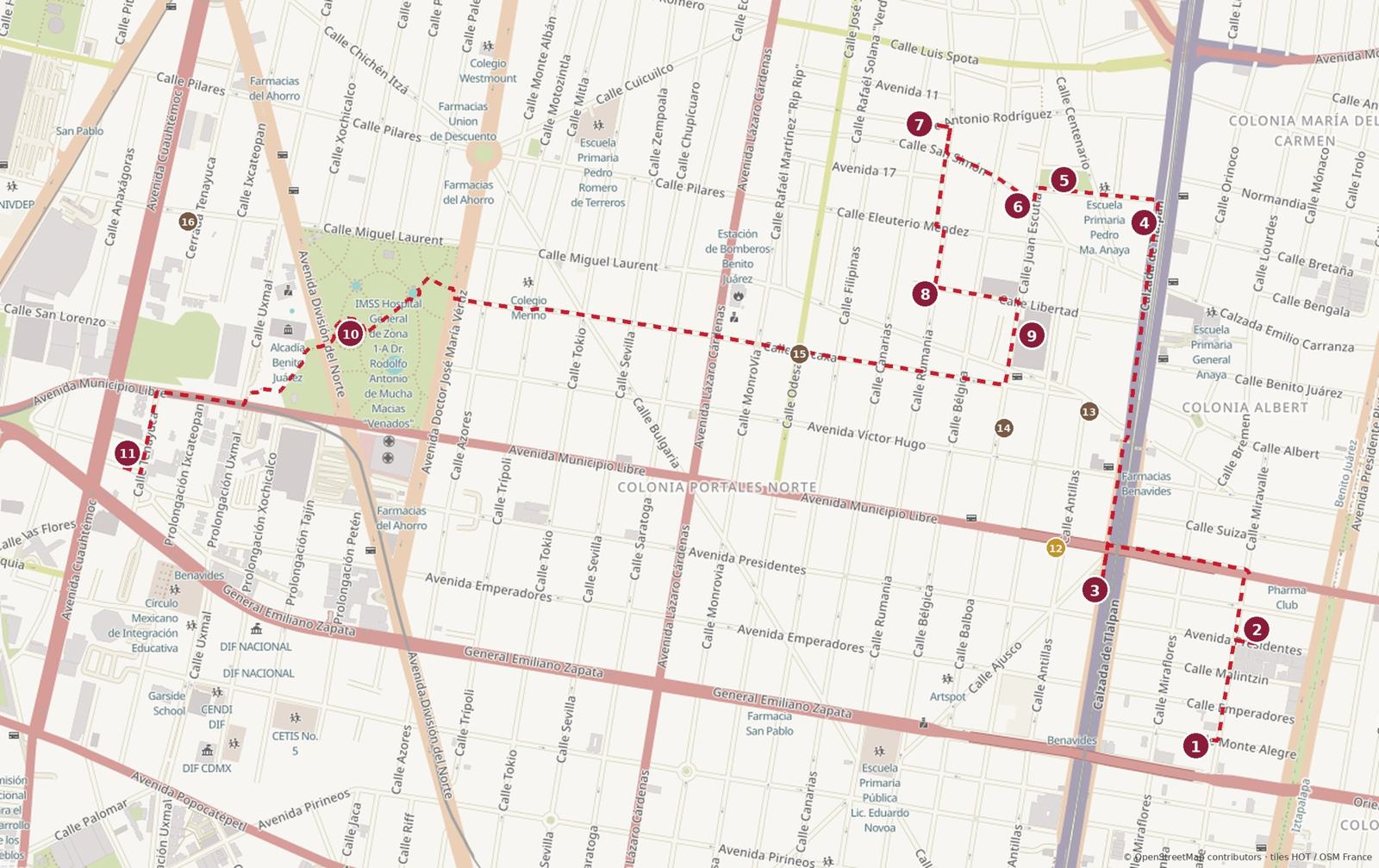
Coffee 13Café La Finca Lina · 14Room Café Especial · 15Elemental Café · 16Xáloh. Amantes del café
Bakeries 12Flower Antilles
Click to enlarge. Map data © OpenStreetMap contributors.
| # | Stop | What it is |
|---|---|---|
| 1 | Casa de Cultura Gaby Brimmer | Cultural center; start |
| 2 | Parroquia de la Sagrada Familia | 1960s modernist church |
| 3 | Parroquia de Cristo Rey | 1940s concrete church |
| 4 | California Dancing Club | 1954 dance hall |
| 5 | Parque San Simón | Village park |
| 6 | Carlos Monsiváis’s house | The chronicler’s home |
| 7 | Templo de San Simón Apóstol | Village church |
| 8 | Tianguis de antigüedades | Antiques and junk street market |
| 9 | Mercado de Portales | 1957 market; lunch |
| 10 | Parque de los Venados | 1957 park with Pancho Villa on horseback |
| 11 | Parroquia de la Santa Cruz de Jerusalén | 16th-century church; end |
The walk, part 1: Portales Oriente to the flea market
The first part crosses Tlalpan. Two big 20th-century churches, the dance hall, then the old village of San Simón and the stalls on Rumania.
1. Casa de Cultura Gaby Brimmer
Monte Alegre 32, Portales Oriente · Mon–Fri 8:00–21:00, Sat–Sun 8:00–20:00 · free
Have the driver drop you on Monte Alegre. A borough cultural center named after Gaby Brimmer (1947–2000), a writer born with cerebral palsy who learned to communicate with the help of her caregiver, Florencia Sánchez Morales, and later campaigned for disability rights. Luis Mandoki made a film of her life, Gaby: A True Story (1987). The center runs dance, painting and yoga classes, and the small gallery shows students’ and visiting artists’ work. Seniors often dance outside.
Breakfast: there is no café worth the name on this first stretch. Eat before you come, or hold out about 20 minutes for Cristo Rey, where a bakery and two good coffee places come one after the other.
2. Parroquia de la Sagrada Familia
Av. Presidentes 21, Portales Oriente · Tue–Sun 7:30–14:00 and 18:00–20:00, Mon evenings only · free
About four minutes north. A modernist church built between 1960 and 1967 by Enrique Carral Icaza, who also worked on Mexico City airport. It takes up a whole block. From the street you see the tall bell tower and a large stained-glass window over the entrance. Inside is a single plain nave with elongated saints. On the 12th of each month there is a rosary procession around the block.
3. Parroquia de Cristo Rey

Calz. de Tlalpan 1409 · Tue–Fri 10:00–14:00 and 17:00–19:00, Sat 10:00–14:00 (check hours) · free
Walk west to Tlalpan and cross by the Metro Portales bridge or at the lights, about eight minutes in all. You have probably seen this church from a Metro train. It was built between 1942 and 1952, when trams still ran down Tlalpan, by the architect Antonio Muñoz García and the naval engineer Miguel Rebolledo, who had learned reinforced concrete in France. The urbanist Iván San Martín compares it to the Perret brothers’ Art Deco churches in France. A big staircase leads up from the southbound lanes. Inside are three naves, a dome, and a lot of colored light from the stained glass. The feast of Christ the King, in late November, brings a fair outside.
Bakery: Flower Antilles at Municipio Libre 58, a minute away (gold circle on the map), daily from 8:00 (Sun from 10:00). A small traditional panadería; around Day of the Dead the pan de muerto comes in hibiscus, guava and cardamom.
Coffee break: on the way north, Café La Finca Lina at Calz. Santa Cruz 18, just off Tlalpan (brown circle on the map), daily from 8:30, roasts its own beans; Chilango says Monsiváis drank coffee there. For better coffee, detour three minutes west to Room Café Especial (Balboa 211, Mon–Fri 8:00–20:00, Sat–Sun 9:00–20:00, brown circle on the map). Small, plain and very good, with filter coffee roasted by Radiante.
4. California Dancing Club

Calz. de Tlalpan 1189 · dances mainly on weekends, check schedule · entry charged on dance days, check price
About ten minutes north up Tlalpan, past Metro Portales, behind a white wall. The California opened in 1954 in the old Cine Bretaña and kept its marble floor, wooden walls and mirrors. On opening night men paid three pesos and women 50 centavos. No alcohol was sold then and the rule largely stands. The regulars dress for it, in pachuco suits and sequined dresses. Bands play danzón, mambo, cumbia and salsa, and there is a dance school. Alejandro González Iñárritu filmed a scene of Bardo (2022) here with more than 400 extras. On a weekday you will see only the wall and the ticket windows.
5. Parque San Simón
Pascual Ortiz Rubio, San Simón Ticumac · open 24 hours · free
Three minutes west, away from the traffic. The village’s park, officially named after President Pascual Ortiz Rubio (1930–1932), but nobody calls it that. There is a playground, a dog run and, at the west end, the Foro Cultural San Simón, a small community theater. Sit on a bench and watch the afternoon school crowd.
6. Carlos Monsiváis’s house
Calz. San Simón 62 · private house, exterior only · free
A minute or two west, at the edge of the park. Carlos Monsiváis (1938–2010), the great chronicler of Mexico City, came here as a boy when his family moved from La Merced, and he lived in this house for the rest of his life with about 24,000 books, magazines and objects, and a lot of cats. He bought secondhand books and records at the Portales market. When he died, the neighbors hung farewell signs on the facade. Toward the end he reportedly said he could not live far from Portales. His library is now in the Biblioteca de México; his collections are in the Museo del Estanquillo downtown. Here there is just a house. Look and move on.
7. Templo de San Simón Apóstol

Calz. San Simón at Antonio Rodríguez · Tue–Sat 8:00–14:00 and 16:00–19:00, Sun 5:00–19:00, closed Mon · free
About four minutes north-west. San Simón Ticumac is one of the original villages of Benito Juárez, and this is its church. A chapel stood here by the middle of the 16th century; the Franciscans built the present church in the 17th and 18th centuries, probably around parts of the old one. Until about 1950 the facade was plastered over. Now it is bare stone, which the neighbors prefer. In 1847 the villagers hid here during the battle. A local story says Empress Carlota once stopped her carriage to hear Mass here. Nobody can prove it.
The streets around the church are narrow and crooked, following old footpaths rather than a grid. Fireworks go off here a lot, above all around the feast of San Simón and San Judas on 28 October.
8. Tianguis de antigüedades de la Portales
Rumania between Libertad and Calz. Santa Cruz · full market Sat–Sun from 9:00, some stalls daily · free
About six minutes south. The reason most people come to Portales. Dealers have sold here for about 70 years, many of them out of the garages along Rumania. It spreads over about four streets, with old photographs, glassware, furniture, records, typewriters, clothing irons, boomboxes, toys, light fixtures, and a great deal of plain junk. The better jewelry and household antiques tend to be on Libertad. Many of the dealers who sell at the fancy antique fairs buy here first.
Sales start around 9:00 but things get going around 11:00, which is about when you should arrive. Bring cash and bargain. Some of the old painted pieces may contain lead, so wash your hands before you eat. Bazar Reto at Fernando Montes de Oca 391, a block away, restores old furniture and has a big showroom of it (daily, check hours).
The walk, part 2: the market to Santa Cruz Atoyac
The second part is lunch, then the quiet half. A long straight walk west through Portales Norte, a big park and an old church to finish.
9. Mercado de Portales

Calz. Santa Cruz at Juan Escutia · daily 8:00–18:00 · free
Three minutes east. The market opened on 10 August 1957 and is named after the hacienda. It is huge and sells almost everything. There is produce, meat, flowers, costumes, uniforms, tailors and repair stalls, and a hardware and bathroom-fixtures market behind it. Locals credit it with inventing the “esquimo,” the milkshake in a plastic cup. On weekends it is packed at midday, so keep a hand on your bag.
Lunch: the fondas in the middle of the market serve comida corrida for about 90 pesos (~5 USD), with huauzontles in pasilla, mole de olla, mixiotes and pozole. The birria and barbacoa stalls are local legends. If you want a table and a menu, Los Pumpos at Alhambra 214 (Tue–Sun 8:00–18:00) cooks Chiapas food, with banana molotes, cochito and tamales from all over the state. Or try Doña Tila La Oaxaqueña at Bélgica 302 (daily from 8:30) for pancita and tlayudas.
From the market it is the longest leg of the walk, about 20 minutes west through Portales Norte to the park. Take the side streets rather than Municipio Libre, which is loud. It is mostly houses and car repair shops.
Coffee break: Elemental Café (Odesa 201 local A, Mon–Sat 9:00–21:00, Sun 9:00–15:00), early on this leg (brown circle on the map). Quiet, with books to borrow, and a drink and a snack for about 100 pesos (~5 USD).
10. Parque de los Venados and the Pancho Villa statue

Av. División del Norte at Municipio Libre · open daily · free
The official name is Parque Francisco Villa; everyone calls it Los Venados, after the deer on its fountains. It was built in 1952–53 on the site of a brickworks and opened on 18 July 1957, when it was the biggest park in the city after Chapultepec. It covers about 9 hectares, with more than 2,000 trees.
The bronze Pancho Villa on horseback, facing División del Norte, is by Julián Martínez Soto. It stood on the Glorieta Riviera until Metro Line 3 was built and moved here in the 1980s. On weekend afternoons (13:00–16:00) the small Planetario Joaquín Gallo, run by volunteers of the Sociedad Astronómica de México, shows short programs (check price). The borough hall of Benito Juárez is on the park’s south side.
Coffee: Xáloh (Miguel Laurent 923, Mon–Fri 7:00–22:00, Sat–Sun 9:00–18:00), about five minutes north-west of the statue (brown circle on the map). A small neighborhood café, good for a last cup before the final stop.
11. Parroquia de la Santa Cruz de Jerusalén
Av. Cuauhtémoc 1316, Santa Cruz Atoyac · Mon–Fri 10:00–14:00 and 16:30–19:30, Sat 10:00–14:00 (check hours) · free
About ten minutes south-west. The church of the old village of Santa Cruz Atoyac was built by Franciscans in the 1560s; the facade says 1564, and the bell tower came in the 17th century. The plateresque doorway is pink and gray stone, with rows of chalchihuites, little jade-disc motifs, carved around the arch. The atrium has very old olive trees and a stone cross with a crown of thorns. Legend says the cross was carved from an idol dug up nearby.
If the doors are open, look inside for the holy water font with Indigenous reliefs and a life-size Christ made of corn-stalk paste, possibly 16th century. It is a surprise to find all this on a loud stretch of Av. Cuauhtémoc. The walk ends here. Get an Uber home, or walk a couple of blocks east to Metro Parque de los Venados.
Late lunch: the Mercado Santa Cruz Atoyac is next door (daily 8:00–17:00). La Cocina de Santa Cruz (locales 89–95, daily 7:30–17:30) is the stall everyone sends you to, for chilaquiles with cecina, enchiladas de mole and fresh juice. If you ate at Portales, skip it.
Coffee, food and drink
For lunch, eat at the Mercado de Portales; for coffee, Room Café; for a drink, Salón Portales or La Paloma Azul.
| Place | What | Where |
|---|---|---|
| Fondas, Mercado de Portales | Comida corrida, birria, barbacoa | Stop 9 |
| La Cocina de Santa Cruz | Market breakfasts, enchiladas de mole | Mercado Santa Cruz Atoyac, at stop 11 |
| Los Pumpos | Chiapas food, tamales | Alhambra 214, by stop 9 |
| Doña Tila La Oaxaqueña | Pancita, tlayudas, mole | Bélgica 302, by stop 9 |
| Rico Tacos Mixiotes | Mixiotes, cecina tacos | Bélgica 303 at Víctor Hugo |
| Salón Portales | Cantina with a Viking theme, free botana | Víctor Hugo 72, by stop 9 |
| Xáloh | Coffee | Miguel Laurent 923, near stop 10 |
| Elemental Café | Coffee, snacks | Odesa 201, between stops 9 and 10 |
| Room Café Especial | Filter coffee | Balboa 211, between stops 3 and 4 |
| Café La Finca Lina | House-roasted coffee | Calz. Santa Cruz 18, between stops 3 and 4 |
| Flower Antilles | Traditional pan dulce | Municipio Libre 58, by stop 3 |
| La Paloma Azul | Pulquería, about 80 years old | Av. Popocatépetl 154, Portales Sur |
| Tierra Adentro | Mexican home cooking | Nevado 112, Portales Sur |
If you just want a familiar cup, the chains are on the edges of the route:
- Cielito Querido at Av. Popocatépetl 468, about 600 m south of stop 11
- Starbucks at Calz. de Tlalpan 1037, under the Walmart, about 700 m north of stop 4
Shops worth the detour
Portales is a place to buy old things.
- Tianguis de antigüedades (stop 8): weekends are best; bring cash.
- Bazar Reto, Fernando Montes de Oca 391: restored antique furniture and odds and ends.
- Mercado de Portales (stop 9): costumes, uniforms, kitchen gear, and the hardware market behind it.
- Café La Finca Lina, Calz. Santa Cruz 18: coffee beans roasted on the spot.
- Marukoshi Bakery, Tokio 824, Portales Sur: Japanese breads shaped like bears and pandas, Tue–Sat from 12:00. Get there early; it sells out.
Which day to walk
Saturday gets you the most. Only the places with limited days or hours are listed below.
| Place | Mon | Tue–Fri | Sat | Sun |
|---|---|---|---|---|
| 3 Cristo Rey | Closed | Open | To 14:00 | Listed closed |
| 4 California Dancing Club | Check | Check | Dances | Dances |
| 7 San Simón | Closed | Open | Open | Open |
| 8 Tianguis de antigüedades | Some stalls | Some stalls | Full | Full |
| 11 Santa Cruz Atoyac | Open, closed 14:00–16:30 | Open, closed 14:00–16:30 | 10:00–14:00 only | Listed closed |
| Los Pumpos (lunch) | Closed | Open | Open | Open |
| Salón Portales | Closed | 12:00–22:00 | To 24:00 | To 24:00 |
On a Saturday, start around 9:30 so Cristo Rey is early and the flea market falls around 11:00. To see inside Santa Cruz Atoyac, take an Uber there from the market before 14:00.
Keep walking
East, before you start: the Museo del Servicio de Transportes Eléctricos, in the trolleybus depot at Municipio Libre 402, San Andrés Tetepilco, is about 10 minutes east of the Sagrada Familia (stop 2), so you could begin there. Old trams and trolleybuses, including the presidential tram used by Álvaro Obregón, and free entry. It opened in 2006. Hours differ by source, so check before you go.
South: Portales Sur. From Metro Ermita, near the start, walk about 1 km south-west to Metro Eje Central for La Paloma Azul pulquería, Marukoshi Bakery and Tierra Adentro on the Glorieta de Canarias.
West: Xoco and Coyoacán. From the Santa Cruz church at the end, the Cineteca Nacional is about 1 km south. Narvarte’s Medalla Milagrosa, Félix Candela’s concrete church, is a short Uber north.
About the author and where to stay
Brian has lived in Roma Norte for about five years and writes the See Mexico City guides. He speaks seven languages and still gets lost on purpose.
When you visit, stay with us at Penthouse El Cielo de Roma in Roma Norte.
Photo credits
Photos via Wikimedia Commons, used under the licenses shown. Numbers match the captions.
- Iglesia Cristo Rey (Portales).jpg, Gerardo Emmanuel Ríos, CC BY 4.0
- Rotulista trabajando en El Salón California Dancing Club.jpg, Hugoscopico, CC BY-SA 4.0
- San Simon Ticuman Church.jpg, Jerry O. R., CC BY-SA 4.0
- Mercado de Portales, Ciudad de México (32956928115).jpg, Comisión Mexicana de Filmaciones from México D. F., México, CC BY-SA 2.0
- Parque de los Venados 02.jpg, GAED, CC BY-SA 3.0
Map: drawn from OpenStreetMap data, © OpenStreetMap contributors, Open Database License.
Sources
Hours and prices checked October 2026; confirm before you go.
- Chilango: Guía para pasear en la colonia Portales
- Chilango: ¿Dónde comer en la Portales? Te damos un tour gastronómico (August 2025)
- Time Out México: 6 favoritos para comer y beber en la Portales (May 2025)
- Time Out México: Restaurantes y cafés en la Portales
- Time Out México: Colonia Portales, proyecto comunitario (September 2025)
- Time Out México: Carlos Monsiváis y la Portales
- Sopitas: La fabulosa historia de la colonia Portales
- Sopitas: Historia del California Dancing Club
- Publimetro: Recorridos históricos por la colonia Portales
- UNAM thesis on the Hacienda de Portales and San Simón Ticumac (PDF)
- La Jornada: PILARES Carlos Monsiváis (July 2023)
- Chilango: Conoce la historia del Parque de los Venados
- Chilango: Museo del Transporte Eléctrico (January 2023)
- Time Out México: Museo del Servicio de Transportes Eléctricos
- Mexico News Daily: From knick-knacks to treasure maps at Portales Antiques Flea Market
- Mexico City tourism: San Simón Ticumac
- Mexico City tourism: Parque San Simón
- Mexico City tourism: Mercado Portales
- Mexico City tourism: Metro Portales
- Mexico City tourism: Santa Cruz Jerusalem (Santa Cruz Atoyac)
- Mexico City tourism: Church of Cristo Rey, Portales
- Mexico City tourism: Sagrada Familia, Portales
- Mexico City tourism: Casa de Cultura Gaby Brimmer
- Mexico City tourism: California Dancing Club
- Mexico City tourism: Electric Transport Museum
- Wikipedia: Portales metro station
- Wikipedia: Parque de los Venados metro station
- Hours and coordinates for cafés, restaurants, markets and churches: Google Maps place listings, October 2026